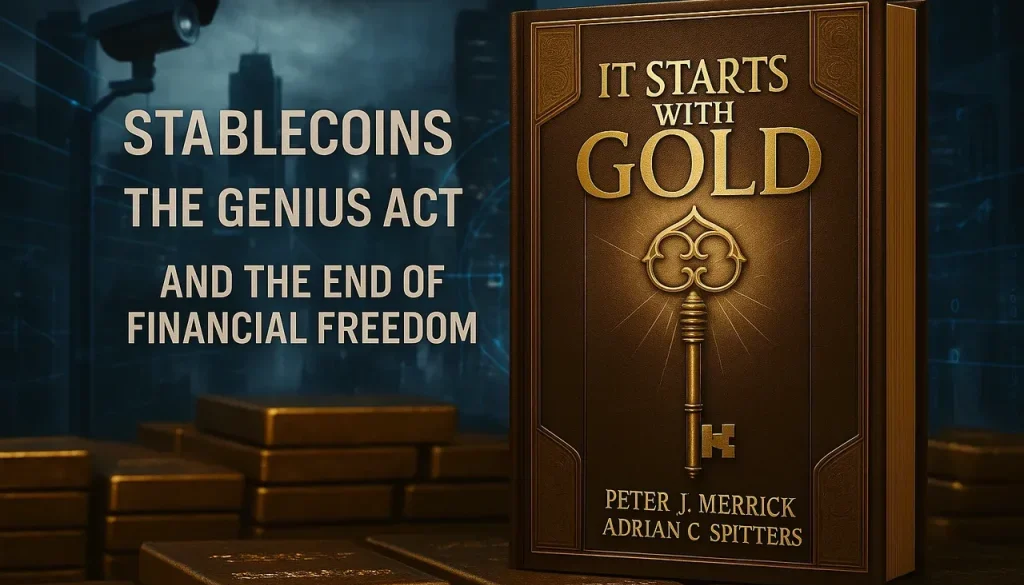
Stablecoins, The GENIUS Act, And The End Of Financial Freedom
By Peter J. Merrick, TEP® and Adrian C. Spitters, CFP®, co-authors of the international bestseller It Starts With Gold™ and the forthcoming book Guns, Gold & Land™
This analysis continues a series of long-form investigations published in The Merrick Spitters Reset Report™
How Washington Armed Wall Street And Silicon Valley To Rewire Money, Sparking Global Consequences
This article explores the GENIUS Act and its link to stablecoins, examining how the legislation reshapes the U.S. financial system while tightening global control. It is presented as an opinion piece based on publicly available information and is intended to inform and invite dialogue.
The Birth Of Stablecoins
The digital currency era began as a rebellion. Bitcoin emerged in 2009, promising freedom from central banks and government oversight. But Bitcoin’s wild volatility made it impractical for daily use. A single news headline could cause swings of 10 percent or more within hours.
To solve this problem, “stablecoins” were created. These digital tokens are pegged to a supposedly stable reference asset, most often the United States dollar, to make digital transactions predictable.
Today, stablecoins occupy a unique position. As of mid-2025, there are more than 265 billion dollars’ worth in circulation. Tether leads the market with over $160 billion, followed by USD Coin at around $60 billion. Beyond those giants, more than 200 other issuers compete for smaller market share.
Compared to the quadrillions traded in derivatives or the trillions in bonds and equities, stablecoins remain small. But scale is not the point. Stablecoins are significant because they are programmable, digital, and global. They are the bridge between cryptocurrency libertarian dreams and government fiscal survival.
Why The GENIUS Act Was Passed
The GENIUS Act, passed in 2025, is Washington’s answer to the debt problem. It provides a comprehensive framework for stablecoins:
- Collateralization: Stablecoins must be backed by U.S. Treasury securities or high-quality deposits of 93 days or less.
- Audit Requirements: Issuers face monthly audits to ensure collateral exists.
- Regulation: The OCC charters and supervises federally qualified issuers; state regulators oversee state issuers; Treasury and other agencies enforce AML/sanctions; FDIC does not insure stablecoins, and the Act polices misrepresentation.
- Restrictions: Issuers may not pass interest earnings to holders. The yield from Treasury bills is kept by issuers, not users.
The purpose is obvious: stablecoins transform everyday transactions into perpetual demand for U.S. debt. Every purchase, every transfer, every remittance, each becomes a micro-purchase of Treasury bills.
The U.S. Debt Trap
To understand the urgency behind this legislation, consider the numbers. The United States now owes more than $37 trillion in federal debt. Annual deficits show no signs of slowing.
Interest payments are on track to about $950 billion in 2025, already rivaling and slightly exceeding defense outlays, with $1 trillion likely by 2026. With each Federal Reserve interest rate hike, the burden grows heavier.
Foreign buyers are stepping away. China has reduced its holdings of U.S. Treasuries. Nations across Asia, Africa, and the Middle East are buying gold or settling trade in non-dollar currencies. This leaves Washington with dwindling options.
The GENIUS Act ensures that, even as foreign demand weakens, domestic and global digital payment systems tied to the dollar will quietly finance U.S. debt. It is debt monetization disguised as innovation.
A History Of Resets
The GENIUS Act is not a random development. It fits into a longer history of financial resets:
- 1920s: Weimar Germany. Central bank money printing led to hyperinflation. A wheelbarrow of currency could not buy a loaf of bread. This showed the danger of financing government spending without restraint.
- 1933: U.S. Gold Confiscation. President Franklin Roosevelt ordered Americans to turn in private gold holdings, replacing them with paper dollars. This was sold as stability but was, in practice, government control over savings.
- 1944: Bretton Woods Agreement. The U.S. dollar became the anchor of global finance, backed by gold.
- 1971: Nixon Shock. The U.S. severed the dollar’s link to gold, moving to fiat currency. This allowed debt to expand without physical restraint.
- 2008: Financial Crisis. Complex derivatives brought the system to the brink of collapse, exposing how hidden leverage can destabilize the world.
- 2019: Jackson Hole. BlackRock’s Investment Institute unveiled the “Going Direct Reset,” a white paper presented at the Federal Reserve’s annual Jackson Hole meeting, recommending that central banks bypass traditional markets and inject liquidity directly into companies and governments.
- 2020–2021: Pandemic Response. Trillions in liquidity flooded Wall Street while Main Street businesses shuttered.
- 2025: The GENIUS Act. Stablecoins are weaponized to ensure rolling demand for Treasury bills.
Each reset has shifted more power to central institutions while eroding individual financial independence. The GENIUS Act is the latest and most dangerous iteration.
Collateral And Control
Stablecoins under the GENIUS Act must be backed by Treasury bills with maturities of 93 days or less. This requirement creates rolling dependence. As these bills expire, issuers must continually reinvest in new government debt.
This structure locks stablecoins into an endless loop of financing U.S. deficits. It also shortens the maturity profile of American debt, making the Treasury more dependent on constant short-term borrowing.
For issuers, the arrangement is highly profitable. They collect interest on Treasury securities while passing none to users. For the government, it guarantees financing. For citizens, it transforms every digital dollar into a silent tax, financing Washington without consent.
Consumer Protection Or Sleight Of Hand?
Supporters argue the GENIUS Act provides clarity and safety in a chaotic crypto market. They point to monthly audits, strict collateral rules, and oversight by regulators.
But these protections serve a deeper purpose. They establish trust in a system designed to transfer wealth upward. Citizens are lured in by the promise of stability, unaware that their participation locks them into financing a government with secret books.
Since 1998, the U.S. Treasury and agencies like the Department of Defense (DoD) and the Department of Housing and Urban Development (HUD) have failed to produce audited financial statements as required by law. In 2017, $21 trillion in undocumented adjustments were exposed. Instead of reforming, Washington legalized secrecy with FASAB Statement 56 (Classified Activities), created by the Federal Accounting Standards Advisory Board in 2018.
Stablecoins funnel money into this black hole. Trust is demanded, transparency denied.
Programmability: A Digital Cage
The most dangerous feature of stablecoins is programmability. Unlike physical cash, stablecoins can be coded to behave differently based on the user, the location, or the transaction.
Imagine a father unable to buy fuel for his truck because his stablecoins are coded for carbon compliance. Imagine a grandmother whose savings are frozen because she donated to the wrong cause. Imagine a small-town store denied the ability to restock because regulators deem its goods non-essential.
This is not theoretical. China has piloted programmable, time-limited digital vouchers and explored constraints consistent with e-CNY programmability. Nigeria rolled out its eNaira, only to face public resistance as citizens rejected digital-only money in favor of cash and alternative assets. Canada’s ArriveCAN app during the pandemic showed how identity and movement-tracking systems can be mandated at scale without democratic debate.
The GENIUS Act lays the groundwork for the same in the United States, but outsourced to private issuers. Critically, these controls can be enforced by algorithms without human oversight.
Outsourcing The CBDC
Central bank digital currencies (CBDCs) have faced strong resistance in the United States. Many state legislatures have even banned them. The GENIUS Act sidesteps this opposition.
By outsourcing issuance to private banks and approved firms, Washington gains the benefits of a CBDC without the political costs. Stablecoins become CBDCs in all but name, programmable, surveilled, and centrally controlled.
The genius of the GENIUS Act is precisely this sleight of hand. It provides the control of a CBDC without the oversight obligations of the Federal Reserve.
Institutional Mapping: Who Benefits
The architecture behind the GENIUS Act involves institutions most citizens barely know.
- OCC (Office of the Comptroller of the Currency): A U.S. Treasury bureau that charters and supervises national banks. Under the Act, it ensures stablecoin issuers comply with Treasury-bill collateralization.
- FDIC (Federal Deposit Insurance Corporation): Originally created to insure bank deposits, the FDIC does not insure stablecoins or other digital assets. Under the Act, its name is invoked in marketing only with strict limits—issuers are banned from implying FDIC insurance.
- Federal Reserve: America’s central bank, responsible for issuing currency and managing interest rates. Stablecoins tethered to Treasuries expand its reach into digital markets.
- BIS (Bank for International Settlements): Based in Basel, Switzerland, it acts as the “central bank of central banks,” promoting global coordination on digital assets.
- IMF (International Monetary Fund): Headquartered in Washington, D.C., it pressures developing nations to adopt digital frameworks and offers funding tied to digital infrastructure.
These are not neutral actors. Each plays a role in building a system where stablecoins reinforce U.S. debt financing and expand global control.
Winners And Losers
Who gains from this transformation?
- The U.S. Treasury: Gains a captive buyer base for short-term debt.
- Issuers: Profit from Treasury yields without passing interest to users.
- Wall Street: Gains a new profit stream by integrating stablecoins into global markets.
- Big Tech: Gains access to financial data through platforms like Apple Pay and Google Pay.
And who loses?
- Citizens: Gain no interest, lose privacy, and become debt financiers without consent.
- Small Businesses: Suffer as banks redirect capital to Treasuries instead of lending locally.
- Sovereign Nations: Find their monetary systems subordinated to Washington’s fiscal needs.
A Planned Economy In Disguise
Stablecoins deepen the transformation of America into a planned economy. Since 2000, banks have been quietly pressured to reduce loans to small businesses and farmers, redirecting funds into Treasuries. Stablecoins accelerate this process.
Instead of credit circulating through Main Street, it cycles through Washington. Local communities weaken while federal power strengthens.
The more money flows through this system, the more control central institutions gain. Over time, the economy becomes less about innovation and more about compliance.
The Illusion Of Freedom
Cash remains the only neutral form of money. A $20 bill works the same in any hand. Stablecoins, by contrast, are programmable. They can be restricted, blocked, or devalued at will.
Freedom is not lost overnight. It erodes transaction by transaction, until every purchase depends on central approval.
When money itself becomes conditional, freedom becomes a memory.
Global Consequences
Although the GENIUS Act is U.S. law, its reach is global. Stablecoins can be marketed worldwide through mobile apps and payment platforms. The Act’s supporters claim it will increase demand for Treasuries, but precise figures remain unverified.
For Europe, this means deeper dependence on the U.S. dollar at a time of energy insecurity and fiscal strain. For Asia, it means competing with Washington’s digital shadow currency while building alternatives. For Africa and Latin America, it means adopting payment systems that quietly siphon capital into U.S. debt.
Canada remains particularly vulnerable. With no national gold reserves and deep financial integration with the U.S., it risks being absorbed into America’s fiscal machinery.
Solutions And Resistance
The GENIUS Act is now law. Stablecoins will grow. But individuals and communities still have choices.
- Defend cash. Insist on physical currency as a parallel option.
- Support local finance. Credit unions and community banks keep money closer to Main Street.
- Own tangible assets. Land, real estate, commodities, and above all, gold.
- Educate families. Intergenerational planning ensures resilience across decades.
- Diversify wealth across jurisdictions. Ensure assets are not locked within one country’s programmable system.
At our firm, we assist clients in structuring wealth by Owning Assets in Order of Asset Security. We prioritize the most secure assets and safeguard those that are most vulnerable.
Book your complimentary review to learn how to structure for the shifts ahead.
If you want a deeper dive into these risks and solutions, you can download a free PDF copy of our international bestseller, It Starts With Gold™. This expanded guide explains how paper systems can trap investors and how families can protect themselves by holding real metal. Download Your Complimentary Copy Here
Final Thoughts
The GENIUS Act is not progress; it is financial capture dressed as innovation. By tethering stablecoins to short-term U.S. debt, Washington has disguised fiscal desperation as digital modernization. Citizens around the world will find themselves financing America’s deficits without realizing it.
The urgent themes discussed here are expanded on in our #1 international best-selling book, It Starts With Gold™, co-authored by Peter J. Merrick, TEP® and Adrian C. Spitters, CFP®. In the book, we reveal how physical gold remains the last form of money beyond digital capture. Visit www.ItStartsWithGold.com.
To find out more, order your own copy of It Starts With Gold™ from Amazon today. CLICK HERE
Stay informed. Stay protected. Subscribe to It Starts With Gold™ on Substack to get the latest article straight to your inbox. 👉 SUBSCRIBE HERE
References
- U.S. Treasury Debt Clock
- Federal Reserve Economic Data (FRED), St. Louis Fed
- Congressional Budget Office 2025 Debt Projections
- Bank for International Settlements (BIS) overview
- Solari Report briefing on the GENIUS Act, July–August 2025
- Guiding and Establishing National Innovation for U.S. Stablecoins Act (GENIUS Act of 2025)
- State Leaders Briefings: The GENIUS Act and Stablecoins with Tobi Maier, Esq.