The BlackRock Global Power Grab Threatening Financial Freedom
By Peter J. Merrick, TEP® and Adrian C. Spitters, CFP®, co-authors of the international bestseller It Starts With Gold™ and the forthcoming book Guns, Gold & Land™
This analysis continues a series of long-form investigations published in The Merrick Spitters Reset Report™
How The World’s Largest Asset Manager Is Reshaping Economies, Politics, And the Future of Your Money
The average person has no idea how deeply BlackRock Inc. has embedded itself into the global economy. It is not simply a money manager. It is a political force, a technology company, and a shadow government rolled into one. What began in 1988 as a risk management venture has grown into a global power center overseeing more than $12.5 trillion in assets directly, and over $21.6 trillion more through its Aladdin technology platform.
This article explores how BlackRock went from obscurity to being the financial giant that shapes policy in Washington, Brussels, London, and beyond. We will also examine what this means for citizens in America and the rest of the Western world.
From Failure to Financial Domination
BlackRock’s origin story is often told with a strange pride. Founder Larry Fink had lost $100 million at First Boston Investment Bank in the 1980s. Out of that failure, he built a system focused on risk management. With early backing from Blackstone, Fink launched what would become BlackRock.
By the late 1990s, it was clear BlackRock was no ordinary investment manager. It developed Aladdin (Asset, Liability, Debt, and Derivative Investment Network), a system that became the backbone of its risk and asset modeling. By the financial crisis of the late 2000s, governments and Wall Street banks alike were calling BlackRock to clean up toxic derivatives. This role gave the firm unparalleled access to confidential data across the financial system.
The Financial Crisis: BlackRock Becomes Indispensable
When the U.S. government bailed out collapsing firms like AIG, Citigroup, and Bear Stearns, who did they call? BlackRock. The firm managed tens of billions in bailout programs, effectively controlling not just private portfolios but also government interventions.
The U.S. Treasury and the Federal Reserve leaned heavily on BlackRock’s expertise, cementing its position as the indispensable middleman in financial rescues. From that moment forward, its influence only grew.
The “Going Direct” Reset
BlackRock soon proposed that central banks bypass traditional monetary policy and inject money directly into the economy. This strategy became known as “going direct.”
Soon after, central banks began interventions that mirrored BlackRock’s blueprint. During the pandemic bailouts, BlackRock was formally hired to manage massive bond-buying programs. The firm not only advised on policy but also purchased its own exchange-traded funds (ETFs) using central bank money.
BlackRock was allowed to design the system, run it, and profit from it.
Aladdin: The Digital Brain of Global Finance
Today, Aladdin manages or monitors more than $21 trillion in global assets. This includes pension funds, sovereign wealth funds, insurance companies, and major corporations. Institutions like Microsoft, Apple, and even rivals like Vanguard and State Street rely on Aladdin’s risk assessments.
Aladdin runs millions of simulations daily, feeding algorithmic decisions that shape the fate of companies, governments, and citizens. BlackRock insists that humans still make final decisions, but the trend is unmistakable. Algorithms increasingly dominate financial flows.
BlackRock is not investing in the future. It is programming it.
The ESG Agenda and Stakeholder Capitalism
For over a decade, Larry Fink has used his annual letter to CEOs to pressure corporations into following his directives. He has declared that “climate risk is investment risk,” signaling a full embrace of Environmental, Social, and Governance (ESG) metrics.
Through ESG, BlackRock is steering companies toward a net-zero agenda dictated by unelected global bodies like the World Economic Forum (WEF). In practice, ESG functions as a form of corporate social credit score. Companies that comply receive investment. Companies that resist find their capital cut off.
The hypocrisy is glaring. BlackRock applies ESG standards aggressively in the United States and Europe, yet remains heavily invested in fossil fuel projects in China and emerging markets. The agenda is not about saving the planet. It is about consolidating control.
ESG is not about the environment. It is about obedience.
Enter Mark Carney: The Policy Enabler
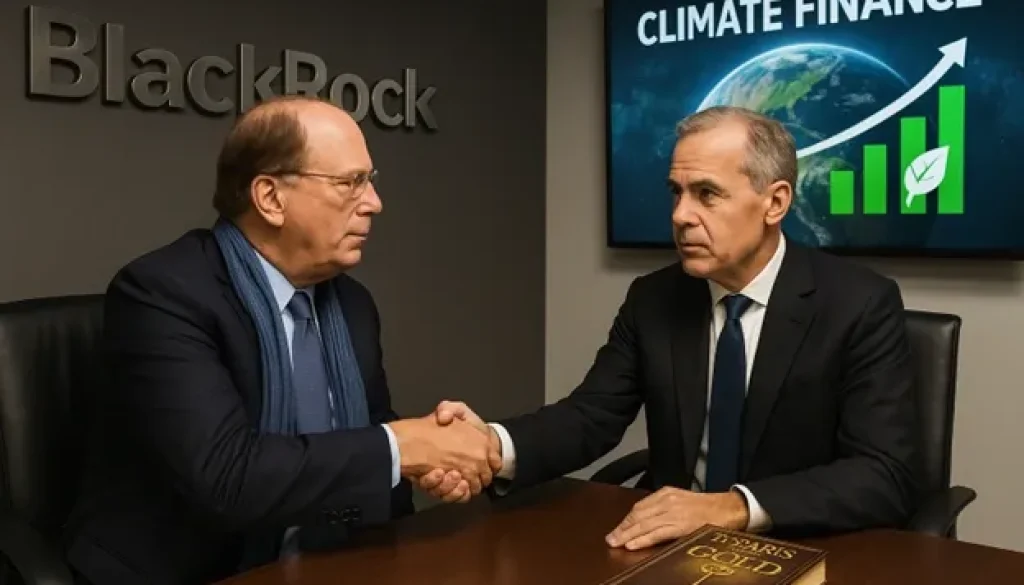
Mark Carney, the former Governor of both the Bank of Canada and the Bank of England, now serves as UN Special Envoy for Climate Action and Finance. He is one of the architects of the global net-zero finance framework.
Carney launched the Task Force on Climate-related Financial Disclosures (TCFD) and co-founded the Glasgow Financial Alliance for Net Zero (GFANZ), which brought together more than $130 trillion of assets under management. BlackRock is one of the largest participants.
Carney did not create BlackRock, but he helped build the regulatory scaffolding that made BlackRock indispensable. By pushing for mandatory climate-risk integration across financial systems, Carney created the demand for exactly what BlackRock’s Aladdin Climate platform was designed to provide.
BlackRock built the machine. Mark Carney wrote the rulebook that forces the world to use it.
Larry Fink Becomes Head of the World Economic Forum
The most dramatic shift came when Larry Fink was appointed interim co-chairman of the World Economic Forum, effectively replacing Klaus Schwab. This moment marked not just a change in leadership but a consolidation of global financial and ideological power into the hands of a single figure.
For decades, Klaus Schwab acted as the architect of the WEF’s “Great Reset,” promoting stakeholder capitalism and centralized global governance. With Fink at the helm, the boundaries between the world’s largest asset manager, which now oversees $12.5 trillion directly, and the world’s most influential policy forum have all but disappeared. His Aladdin platform already influences more than $21.6 trillion in assets, amplifying the integration of financial markets with global governance agendas.
At Davos, Fink no longer arrives as a participant. He now chairs the table. Under his leadership, the WEF’s agenda is likely to become more financialized, data-driven, and directly tied to BlackRock’s enforcement tools.
The implications are staggering. Under Schwab, the WEF functioned as a forum of elites. Under Fink, it risks becoming the command center of global capital allocation. Environmental, social, and governance scores, climate mandates, and digital currencies are no longer abstract policy goals; they become programmable levers controlled by the same man who manages the capital flows behind them.
This appointment signals a future where dissent may not simply be discouraged but priced out of existence. Imagine a system where every loan, investment, or purchase is tied to compliance codes originating in Davos, enforced through Aladdin analytics, and integrated into central bank digital currencies. The WEF, once framed as a debating platform, transforms into an operating system for global financial and political control.
Larry Fink replacing Klaus Schwab is not a mere succession. It is succession with enforcement power. For the first time, policymaker and financier are embodied in the same individual.
Central Bank Digital Currencies: The Next Stage
BlackRock has also aligned itself with central bank digital currencies (CBDCs). CBDCs would allow governments and their financial partners to monitor every transaction, enforce policy through programmable money, and freeze accounts at will.
With Aladdin and ESG as enforcement mechanisms, and CBDCs as the rails, BlackRock is positioned to shape not just investment flows but daily economic life.
A day in the future may look like this: a worker’s digital wallet is restricted because he bought too much gasoline that month. His mortgage is repriced because his home heating system is non-compliant with carbon mandates. His pension shows losses because it was shifted into “sustainable” funds yielding little return.
When money becomes data, freedom becomes permission.
Street-Level Impact: Housing, Pensions, Farmers
- Housing: BlackRock has been buying up homes across America, often paying cash over asking price. Families are outbid, communities are reshaped into corporate rental blocks.
- Pensions: Millions of workers have pensions managed through BlackRock. They may not realize that their future is tied to ESG-driven experiments.
- Farmers and small businesses: ESG-linked financing means farmers may lose loans if they fail carbon scoring, and small businesses may be denied credit if they do not meet digital compliance mandates.
The same firm that sets climate standards can decide if your farm gets a loan or if your children ever own a home.
Pushback Against BlackRock
The tide may be turning. Attorneys general in multiple U.S. states have accused BlackRock of violating fiduciary duty by prioritizing ESG over financial returns. Several states have already divested billions from BlackRock’s control.
These actions show that public awareness is rising. Politicians are reacting because citizens are starting to question how a private company came to wield such power over their pensions, investments, and freedoms.
Hope Through Awareness and Action
Awareness is the first step. As more people understand the scope of BlackRock’s power, the easier it becomes to resist. States are already showing that divestment is possible. Citizens can choose financial institutions outside the BlackRock orbit, hold physical assets like gold and silver, and support local businesses not tied to ESG mandates.
If you want a deeper dive into these risks and solutions, you can download a free PDF copy of our international bestseller, It Starts With Gold™. This expanded guide explains how paper systems can trap investors and how families can protect themselves by holding real metal. Download Your Complimentary Copy Here
Building Wealth Outside the System
At our firm, we assist clients in structuring wealth by Owning Assets in Order of Asset Security. We prioritize the most secure assets and safeguard those that are most vulnerable.
Book your complimentary review to learn how to structure for the shifts ahead.
Final Thoughts
BlackRock’s rise is not simply a story of corporate success. It is the consolidation of financial, technological, and political control into one unelected entity. Left unchecked, it will shape the future of money, business, and personal freedom.
The urgent themes discussed here are expanded on in our #1 international best-selling book, It Starts With Gold™, co-authored by Peter J. Merrick, TEP® and Adrian C. Spitters, CFP® . In the book, we reveal how BlackRock’s control grid ties into the broader financial reset and how individuals can take back control by securing physical assets. Visit www.ItStartsWithGold.com.
To find out more, order your own copy of It Starts With Gold™ from Amazon today. CLICK HERE
Stay informed. Stay protected. Subscribe to It Starts With Gold™ on Substack to get the latest article straight to your inbox. 👉 SUBSCRIBE HERE
References
- Investment Management Agreement: FRB-NY and BlackRock Financial Management (2008)
- Corbett Report, How BlackRock Conquered the World (2025) YouTube Video
- Federal Reserve, Balance Sheet Data (August 2025) FRED
- U.S. Congressional Budget Office, January 2025 Debt Projections CBO Report
- Bank for International Settlements, Unified Ledger Reports (2025) BIS
- Reuters, “BlackRock ESG push faces political backlash” (May 2025)
- Bloomberg, “Why ESG Faces Backlash Under Trump 2.0” (March 2025)
- Financial Times, “ESG fund outflows hit record as sustainable investing backlash grows” (July 2025)
- UN, “Mark Carney appointed UN Special Envoy for Climate Action and Finance” (2020)