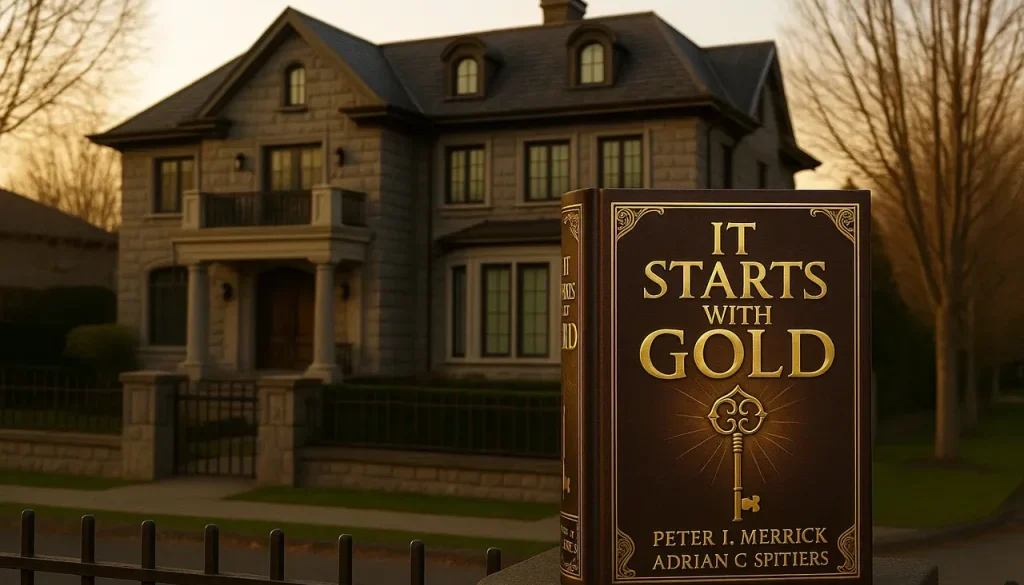
The Dark Future of Boomer Homes
By Peter J. Merrick, TEP® and Adrian C. Spitters, CFP®, co-authors of the international bestseller It Starts With Gold™ and the forthcoming book Guns, Gold & Land™
This analysis continues a series of long-form investigations published in The Merrick Spitters Reset Report™
Why the properties that once symbolized success may soon become financial traps
For decades, the North American dream was built on a house. The bigger the better. A manicured lawn, a two or three car garage, a sprawling family room, a kitchen fitted with imported stone countertops, these were the marks of achievement. Boomers bought into this dream, expanded it, and in many cases, built their identities around it. To them, the home was not just shelter. It was security, status, and a symbol of permanence.
But permanence is not protection. A house cannot freeze time. Ownership cannot halt demographic tides. The homes that once defined success are now beginning to look less like fortresses and more like traps. Families that believed they had secured a lasting legacy are finding themselves cornered, unable to sell when they want, unable to pass on what they imagined, and unable to preserve the wealth they thought their homes contained.
The demographic wave no one can outlive
Demographics are destiny. Adults over the age of 55 now own the majority of homes in North America, and not just any homes. Boomers disproportionately hold the largest, most expensive properties. They control the “forever homes” that were built in the 1980s and 1990s, financed by cheap credit and buoyed by decades of rising values.
👉 Subscribe to The Merrick Spitters Reset Report™ and receive a digital copy of our international bestseller, It Starts With Gold™, along with our white paper, Last Asset Standing™ and early updates on our forthcoming book, Killing Crypto™.
But the actuarial tables are unyielding. By the 2030s, mortality among the boomer generation will surge. In the United States, the annual number of deaths is projected to rise from roughly 3.3 million today to nearly 4.5 million by 2040. Canada will see a doubling of deaths among those over 65 within the same period. Behind each statistic is a home, often large and expensive, returning to the market.
Studies project that between 8 and 10 million United States homes will be vacated by older Americans over the next decade, either through downsizing or death. In Canada, where boomers make up more than 9 million people, nearly a quarter of the population, the demographic wave is equally unforgiving. The supply of homes coming to market through inheritance and forced sales will overwhelm the buyer base.
Boomers cannot outlive this tide. Their heirs cannot absorb the flood.
Inheritance that erodes instead of preserves
Boomers often imagine leaving their homes as legacies. They picture their children celebrating family milestones in the same rooms, raising their own families under the same roof. But the reality is harsher.
Heirs inherit pressure, not permanence. They face rising property taxes, ballooning insurance premiums, and maintenance costs that cannot be ignored. They often live in other cities, with careers and families of their own. They do not want to manage a property that feels like an anchor. Many cannot afford to.
A family in Ontario learned this after their father’s passing. The estate included a lakeside property worth 2.5 million dollars on paper. But within months, deferred maintenance revealed itself, a leaking roof, a rotting deck, and a septic system in need of replacement. The children could not carry the costs. They listed quickly, cutting the price multiple times. In the end, the home sold for just over 1.7 million dollars. What had been intended as a proud inheritance dissolved into a stressful fire sale.
This is not the exception. It is becoming the rule. What looks like legacy turns into liquidation. What parents believe they are giving cannot be kept, and what heirs receive cannot be held.
In Canada, the risks run deeper. While no federal home equity tax exists today, think tanks and political leaders have floated the idea of taxing the equity growth in principal residences. For boomers, whose wealth is often tied up in homes, even the debate introduces uncertainty. If such a tax were ever implemented, heirs could find themselves inheriting not just a property but a bill, compounding the costs of upkeep, insurance, and probate.
Regional markets trapped in decline
The dynamics vary across borders, but the outcome is the same. In the United States, younger families are unwilling to trade up into larger, higher cost properties because of the mortgage lock in effect. Nearly every homeowner has a fixed mortgage, and more than half are locked below 4 percent, making big houses harder to sell.
In the Northeast and Midwest, population stagnation compounds the problem. Towns in Ohio, Pennsylvania, and Michigan are filled with large homes owned by aging boomers. Demand is low, younger families are leaving, and buyers are scarce. In Sunbelt states like Florida and Arizona, migration still fuels sales, but even there, insurance costs have become a deterrent. Some Florida homeowners now pay more than 10,000 dollars annually for basic coverage.
In Canada, the trap is even tighter. For decades, international buyers provided an exit for boomers looking to sell high end properties in Toronto, Vancouver, and Victoria. That door is now closed. Ottawa’s ban on foreign buyers, extended until 2027, has cut off that escape route. Domestic buyers cannot fill the gap. In Toronto, the median household income is around 97,000 dollars, yet the average detached home price exceeds 1.3 million dollars. The math does not work. The pool of buyers who can afford boomer trophy homes is shrinking, and policy has narrowed it further.
Trophy homes stripped of their shine
The cultural meaning of a home has shifted. For younger generations, space is no longer the ultimate symbol of success. Efficiency, convenience, and sustainability now matter more than size. Walkability trumps three car garages. Solar panels and energy efficiency outweigh cathedral ceilings.
Developers understand this better than anyone. Increasingly, they see more value in the land than the structures standing on it. A once prized dream home becomes an obstacle to redevelopment. Bulldozers replace memories with density. What took a lifetime to build can be erased in weeks, its legacy reduced to lot value.
Consider a Vancouver homeowner who spent decades perfecting a 6,000 square foot property in Shaughnessy. The home was appraised at over 5 million dollars. Yet when it came to market, the eventual buyer was not a family eager to preserve it, but a developer who planned to demolish it and replace it with townhomes. To the market, the land mattered. The home did not.
History’s warnings that cannot be ignored
This is not an abstract theory. History provides examples of what happens when demographics overwhelm housing markets. In Japan, the akiya crisis has left more than 8 million homes vacant, many given away for free or abandoned altogether. Entire villages have been hollowed out. Once valued family properties have become liabilities no one wants.
North America has seen its own previews. After the 2008 financial crisis, McMansions across the United States Sunbelt became stranded assets. Streets lined with oversized houses sat empty, their values slashed as families walked away. In Canada, investor owned condo towers in Toronto and Vancouver stand half empty, a sign of what happens when speculation and demographics collide. The pattern is clear. When supply floods a market without enough demand, value collapses.
Earlier history offers the same warning. In post war Britain, the decline of country estates saw thousands of sprawling homes demolished. Families who once considered their homes eternal legacies could no longer afford the upkeep. What seemed permanent was erased within a generation.
The financial system turns homes into revenue streams
Even if prices remain stable, carrying costs relentlessly drain equity. Municipalities, strapped by pension liabilities and deficits, lean harder on property taxes. Insurers hike premiums every year, especially in areas prone to wildfire, flooding, or storms. Governments look to property as an easy revenue source, layering speculation taxes, vacancy fees, and estate levies on top of ownership.
In British Columbia, the speculation and vacancy tax penalizes homes left empty. Ontario imposes high land transfer taxes. In the United States, proposals to lower the federal estate tax threshold would bring more middle class families into its net. Everywhere, property wealth is being targeted.
Climate policy adds another layer. To meet net zero targets, governments in Canada and the United States are mandating or incentivizing retrofits of older housing stock. Insulation upgrades, high efficiency windows, electric heat pumps, and solar readiness are part of this push. While positioned as climate action, these retrofits come with significant costs. Grants and loans such as Canada’s Greener Homes Initiative or U.S. Inflation Reduction Act rebates offset some expenses, but many families face gaps in financing and compliance. For older homeowners on fixed incomes, mandatory upgrades risk turning houses into financial burdens rather than assets.
Climate financing further complicates the picture. Central banks, regulators, and municipalities are embedding climate risk into lending standards and property insurance. Banks increasingly price mortgages and credit with climate disclosure requirements, while insurers raise premiums or withdraw coverage in high risk zones. What once felt like a secure family asset now sits exposed to a web of climate related costs that siphon equity away year after year.
The bigger the home, the bigger the target. What once felt like wealth becomes a pipeline for extraction. The financial industrial complex treats boomer homes not as legacies to be passed down, but as resources to be mined. Families discover too late that their wealth is not preserved, but consumed.
Two doors, both leading to loss
This is the trap boomers now face. They can sell now, accepting less than they imagined, preserving some liquidity but losing pride. Or they can wait, paying rising costs year after year, only to leave heirs who must sell quickly into an oversupplied market.
One path drains equity slowly. The other destroys it all at once. Both lead to the same destination. The house that was supposed to protect becomes the very source of loss.
The resentment of heirs
Resentment deepens the divide. To many millennials and Gen Z, boomer homes are not blessings but burdens. They see them as symbols of inequity, proof that their parents enjoyed decades of appreciation while they are priced out of basic ownership.
A young couple in Calgary inherited a suburban estate after both parents passed within a year. They lasted less than three months in the home. The taxes were too high, the commute was too long, and the upkeep was too demanding. They sold quickly, frustrated that what was meant to be a gift felt more like punishment.
Heirs do not cling to these homes. They liquidate them, often with bitterness. The generational dream of the home as a permanent foundation collapses under the weight of resentment.
Why this starts with gold
In the end, the boomer home becomes what its owners never intended, a prison disguised as a fortress. It ties up wealth in illiquid walls, forces heirs into obligations they cannot manage, and leaves families with choices that all end in erosion.
This is why our work begins elsewhere. In It Starts With Gold™, we wrote that true security is not built on illusions of permanence. It is built on assets that endure across regimes, across policies, and across generations.
Gold does not depend on local buyers or foreign demand. It is not eroded by property taxes or insurance premiums. It does not vanish in probate disputes or crumble when cultural tastes change. Unlike a house, it cannot become obsolete. Unlike an estate, it does not pit heirs against one another in forced liquidation. Gold is portable, divisible, and universally recognized.
In the 1970s, as inflation gutted savings, gold soared more than one thousand percent. In Weimar Germany, gold preserved purchasing power while property wealth collapsed under hyperinflation. In 2008, gold rose even as property markets imploded. Through every collapse in history, gold has provided continuity when other assets failed.
Boomers built the houses that defined their era. But eras end. The dark future of these homes is not about pride or beauty. It is about liquidity lost, legacies diminished, and burdens passed down instead of wealth. Families who act now will preserve what matters. Families who wait will leave behind not security, but walls.
Real wealth does not begin with a house that may never sell.
It starts with gold.
From analysis to action
At our firm, we help clients avoid the trap of tying their wealth to assets that can erode under demographic tides, policy shifts, and market shocks. We do this by structuring wealth according to Owning Assets in Order of Asset Security, prioritizing those that endure and safeguarding those most exposed to loss.
👉Book your complimentary review to learn how to structure your wealth for the shifts ahead.
👉 Sign up today for The Merrick Spitters Reset Report™ and receive a digital copy of our international bestseller, It Starts With Gold™, our White Paper, Last Asset Standing™, and early updates on our upcoming book, Killing Crypto™.
Stay informed. Stay prepared. Take action while you still have the freedom to choose.
The insights you’ll receive connect directly to the urgent themes expanded in the number one international bestseller, It Starts With Gold™, co-authored by Peter J. Merrick, TEP® and Adrian C. Spitters, CFP®.
Inside It Starts With Gold™, the authors outline how to establish a foundation of tangible assets, how to assess assets by their relative security, and how to prepare for systemic shocks and market upheavals while maintaining control of the future. Visit www.ItStartsWithGold.com.
Prefer a hard copy of It Starts With Gold™? You can order one from Amazon now.
References
- Construction Coverage – Baby Boomer-Dominant Housing Markets (2024)
- National Mortgage Professional – When Will Baby Boomers Relinquish Their Homes?
- Fannie Mae – Housing Insights: The Coming Exodus of Older Homeowners
- National Mortgage News – 4M Baby Boomer Homes Should Hit Market Each Year Till 2032
- Government of Canada – Extension of Ban on Foreign Ownership of Canadian Housing to 2027
- Harvard Joint Center for Housing Studies – New Projections on Household Growth and Housing Demand
- National Mortgage Professional – Boomers Own Half of $34 Trillion Equity Pie
- Realtor.com – Where Baby Boomers Hold the Most Housing Wealth
- NAR – Baby Boomers Regain Top Spot as Largest Share of Home Buyers
- Efficiency Canada – Canada’s Retrofit Mission and Deep Energy Retrofits
- Government of Canada – Canada Greener Homes Initiative
- U.S. Department of Energy – Save Energy, Save Money
- U.S. Department of Energy – Property Assessed Clean Energy Programs
- Deeded – The Home Equity Tax Debate in Canada