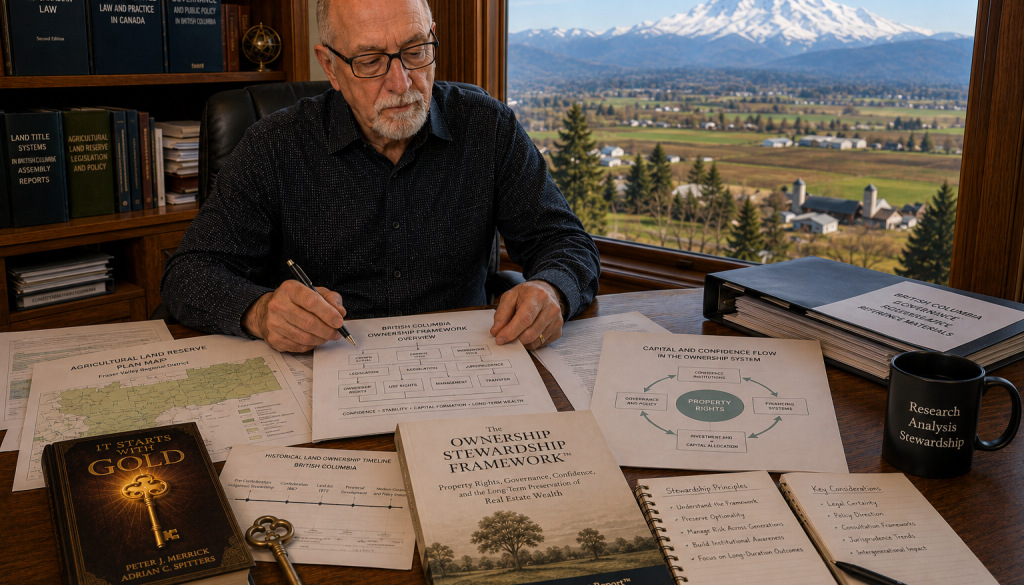
The Ownership Stewardship Framework™
By Adrian C. Spitters, FCSI® and Peter J. Merrick, TEP®
This article is part of an ongoing series published through The Merrick Spitters Reset Report™ examining long-term developments affecting property rights, financial systems, and wealth preservation.
Property Rights, Governance, Confidence, and the Long-Term Preservation of Real Estate Wealth
Most property owners spend their lives focusing on the asset itself. They focus on the home, the farm, the commercial building, the development property, or the investment portfolio. Far fewer spend time examining the ownership framework that makes those assets valuable in the first place.
Yet history repeatedly demonstrates that ownership systems, governance structures, legal frameworks, and confidence are often more important than the assets themselves. Assets derive value from the systems surrounding them. When those systems are trusted, capital flows freely. When confidence begins to change, behaviour often changes long before prices do.
Understanding this relationship has become increasingly important for families, investors, businesses, and long-duration stewards of real estate wealth.
This assumption has influenced countless financial decisions throughout Canada. Residential real estate has become a primary retirement asset for many households. Agricultural land has provided both productive capacity and generational wealth preservation for farm families. Commercial properties have served as stores of capital, sources of income, and collateral supporting business growth. Development land has been accumulated in anticipation of future demand and economic expansion. Across each of these categories, ownership has functioned as more than a legal designation. It has become an organizing principle through which families, businesses, and institutions plan for the future.
The significance of ownership extends beyond the individual asset itself. Ownership influences lending decisions, investment behaviour, succession planning, tax planning, infrastructure development, municipal growth, and the allocation of capital throughout an economy. Confidence in ownership frameworks encourages investment, facilitates financing, and supports the long-term planning horizons required for productive economic activity. Conversely, uncertainty surrounding ownership frameworks can influence behaviour long before any formal legal or policy changes occur. Capital often responds not only to current conditions but also to evolving perceptions regarding stability, predictability, and future governance.
Recent discussions concerning property rights, Aboriginal title, governance authority, land-use frameworks, consultation requirements, and the evolution of ownership-related legal interpretations have prompted a growing number of property owners, investors, professionals, and institutions to examine questions that previously attracted limited attention outside legal and academic circles. While opinions regarding these developments vary considerably, their emergence has highlighted an important reality: ownership is not merely an asset-level consideration. It exists within a broader architecture that includes constitutional principles, governance structures, legal precedents, regulatory frameworks, financial systems, and social agreements.
The purpose of this publication is not to advocate for a particular legal interpretation, political position, or policy outcome. Rather, it is to examine ownership through a stewardship lens. Stewardship differs from ownership. Ownership concerns legal rights and interests. Stewardship concerns the responsible preservation, management, and transfer of assets across time. A stewardship perspective requires understanding not only the asset itself but also the environment within which the asset exists.
For family enterprises, farm families, real estate investors, developers, trustees, family offices, and long-duration capital allocators, this distinction is particularly important. Decisions involving real estate often extend beyond immediate market conditions and into multi-decade planning horizons. Such decisions require consideration of financing systems, governance trends, legal developments, demographic changes, economic conditions, and broader factors influencing confidence. Understanding these interconnected relationships does not eliminate uncertainty, but it can improve the quality of decision-making in environments where assumptions are evolving.
This booklet therefore begins not with current market conditions, political debates, or specific legal disputes, but with a more fundamental question: why do ownership systems matter in the first place? Before examining emerging developments, it is necessary to understand the role ownership frameworks play in supporting confidence, facilitating capital formation, and preserving long-term wealth. Only then can broader stewardship implications be properly evaluated.
Why Ownership Systems Matter
Ownership systems are among the least discussed yet most important foundations supporting modern economies. Their significance is often overlooked precisely because they function quietly and continuously in the background. Individuals purchase property, lenders extend credit, businesses invest capital, governments collect taxes, and families transfer wealth between generations without regularly examining the institutional architecture that makes these activities possible. Yet every one of these transactions depends upon a shared belief that ownership rights are sufficiently clear, enforceable, and durable to justify long-term commitments of capital and effort.
At their core, ownership systems perform a critical economic function. They establish a framework through which rights, obligations, responsibilities, and expectations can be organized across society. Without clearly defined ownership frameworks, economic coordination becomes substantially more difficult. Individuals become less willing to invest in improvements, lenders become less willing to provide financing, businesses become more hesitant to commit capital, and long-term planning horizons begin to shorten. Ownership systems therefore serve not merely as legal structures but as mechanisms that facilitate trust between participants who may never directly interact with one another.
The relationship between ownership and confidence is particularly important. Confidence is often discussed in relation to financial markets, banking systems, and economic growth, yet confidence also plays a central role in property markets. The value of real estate is not determined solely by physical characteristics such as location, improvements, acreage, productivity, or development potential. Real estate derives value from the confidence that buyers, lenders, investors, businesses, and institutions place in the framework governing its ownership and use. When participants believe that ownership rights will remain stable and predictable, capital tends to flow more freely. Financing becomes more readily available. Investment horizons lengthen. Development activity increases. Economic activity expands.
Conversely, when uncertainty begins to emerge regarding ownership frameworks, confidence can become more fragile. This does not necessarily mean that values immediately decline or that markets cease functioning. Rather, participants begin reassessing assumptions that may have previously gone unquestioned. Lenders may adjust risk assessments. Investors may seek additional information before committing capital. Developers may reconsider project timelines. Institutions may evaluate alternative jurisdictions. Families may revisit succession plans. These behavioural responses often occur gradually and can emerge long before any measurable economic impact becomes visible.
History demonstrates that ownership systems influence far more than individual transactions. Throughout the development of modern economies, the security and predictability of ownership frameworks have frequently served as distinguishing characteristics separating jurisdictions that attract long-term investment from those that struggle to retain capital. Investors rarely allocate resources based solely upon current market conditions. They also consider governance quality, legal predictability, regulatory stability, dispute-resolution mechanisms, and broader institutional confidence. Ownership frameworks therefore function as part of a larger ecosystem influencing capital allocation decisions across generations.
This relationship becomes increasingly important when considering long-duration assets. Real estate differs from many other asset classes because ownership decisions often span decades rather than months or years. Agricultural properties may remain within the same family for multiple generations. Commercial properties may serve as long-term stores of capital. Development lands may require years before reaching their intended use. Family enterprises frequently depend upon real estate assets that support business operations, succession plans, and retirement objectives simultaneously. The longer the ownership horizon, the more significant the surrounding governance and ownership frameworks become.
For stewards of significant real estate holdings, understanding ownership systems is therefore not an academic exercise. It is a practical component of long-term planning. Stewardship requires awareness not only of current market conditions but also of the broader structures influencing how ownership is defined, protected, financed, transferred, and valued over time. The objective is not to anticipate every possible legal, political, or economic development. Rather, it is to recognize that ownership exists within a dynamic environment where institutions, governance frameworks, and societal expectations continue to evolve.
Understanding ownership systems also requires acknowledging that ownership itself is not a static concept. Throughout history, societies have continually refined how ownership rights are defined and balanced against competing interests. Property rights, governance authority, resource management, environmental considerations, Indigenous rights, development objectives, and public policy priorities have all influenced the evolution of ownership frameworks. These changes have often occurred gradually through legal decisions, legislative reforms, regulatory developments, and shifting social expectations rather than through abrupt transformations.
The questions emerging today concerning ownership, governance, and confidence should therefore be viewed within this broader historical context. They are not isolated events. They represent part of an ongoing process through which societies continually negotiate the relationship between private ownership, public interests, governance structures, and long-term economic development. For stewards of real estate assets, understanding this process is becoming increasingly important because it influences the environment within which future decisions will be made.
To understand how contemporary ownership discussions emerged, it is helpful to begin with one of the most important stewardship decisions in British Columbia’s history. Long before current debates regarding Aboriginal title, consultation frameworks, and DRIPA, British Columbia was already grappling with a fundamental question: how should ownership rights be balanced against long-term societal objectives?
The Agricultural Land Reserve and the Stewardship of Productive Land
One of the most important yet often overlooked chapters in British Columbia’s ownership story began long before contemporary discussions surrounding Aboriginal title, UNDRIP, or DRIPA. In 1973, the Province of British Columbia established the Agricultural Land Reserve, creating one of the most ambitious agricultural land preservation frameworks in North America. The Agricultural Land Reserve fundamentally altered how ownership and land use would interact within the province by introducing the principle that certain lands would be protected not merely for the benefit of current owners, but also for future generations.
At the time, concerns were growing that productive agricultural land was disappearing through urban expansion, speculation, and development pressure. British Columbia possessed a limited amount of highly productive agricultural land relative to its overall geographic size. Despite being one of Canada’s largest provinces, productive agricultural land remained a limited and strategically important resource. Policymakers feared that once productive farmland was lost, it could never be recovered. The Agricultural Land Reserve was therefore established to preserve long-term food production capacity by restricting non-agricultural uses on designated lands.
The Agricultural Land Reserve was revolutionary because it challenged a traditional assumption held by many property owners. Prior to its creation, ownership was often viewed primarily through the lens of individual control and market value. The Agricultural Land Reserve introduced a competing principle: certain assets may possess importance beyond their immediate economic value to individual owners. Productive farmland was increasingly viewed as a strategic provincial asset tied to long-term food security, economic resilience, and future population needs.
The policy emerged during a period when rapid urban expansion was consuming productive agricultural land throughout several regions of the province. Policymakers recognized that while cities could continue expanding, productive farmland could not easily be recreated once lost. British Columbia faced a particularly unique challenge because only a small percentage of its land base was capable of supporting intensive agricultural production. Much of the province consists of mountains, forests, and terrain unsuitable for large-scale farming. This meant that the preservation of productive agricultural land carried implications extending far beyond individual property ownership.
The Agricultural Land Reserve therefore established an important precedent within British Columbia’s ownership framework. It demonstrated that governments were willing to impose limitations on certain property uses when broader societal objectives were considered sufficiently important. Whether one views this development favourably or critically, it represented a significant evolution in the relationship between ownership and stewardship. The debate was no longer solely about who owned the land. It increasingly involved questions regarding how the land would be used, what public interests might be involved, and how competing objectives should be balanced over time.
This distinction remains highly relevant today because it illustrates that ownership discussions in British Columbia have long involved more than simple questions of title and possession. The Agricultural Land Reserve demonstrated decades ago that ownership rights, public policy objectives, long-term stewardship considerations, and societal interests could become interconnected within a single governance framework.
British Columbia’s circumstances made this stewardship challenge particularly acute. Although the province covers a vast geographic area, only a very small percentage of its land base is capable of supporting intensive agricultural production. Much of British Columbia consists of mountains, forests, rock, and terrain unsuitable for large-scale food production. As population growth accelerated throughout the Lower Mainland, Fraser Valley, Okanagan, and Vancouver Island, pressure on productive farmland increased significantly.
This reality created a governance dilemma that remains relevant today. Policymakers were forced to balance private ownership rights against broader concerns involving food production, long-term land stewardship, population growth, and economic development. The Agricultural Land Reserve became one of the earliest large-scale examples of how ownership, stewardship, governance, and public policy could become intertwined within British Columbia’s evolving ownership framework.
The significance of the Agricultural Land Reserve extends beyond agriculture itself. It demonstrated an important principle that continues influencing ownership discussions today. Ownership rights remained intact, but those rights increasingly existed within a broader framework of societal objectives. Property owners retained title and many traditional ownership rights, yet the use of the land became subject to restrictions intended to serve longer-term public interests.
For decades, the Agricultural Land Reserve has shaped investment decisions, development patterns, succession planning strategies, and land valuations across British Columbia. Supporters view it as one of the most successful farmland preservation programs in North America. Critics argue that it limits flexibility and creates economic distortions. Regardless of perspective, the Agricultural Land Reserve illustrates a broader reality that is highly relevant to modern stewardship discussions: ownership has long existed within a framework balancing private interests and public objectives.
Understanding this history is important because contemporary discussions surrounding governance, land use, Aboriginal title, consultation frameworks, and ownership rights did not emerge in a vacuum. They developed within a province that has been actively negotiating the relationship between ownership, stewardship, development, and public policy for decades. The Agricultural Land Reserve therefore serves as an important bridge between traditional ownership concepts and the more complex governance discussions that continue evolving today.
The Evolution of Ownership in British Columbia
Modern discussions surrounding ownership, property rights, governance, and land-use authority often assume that the ownership systems operating today have always existed in their current form. In reality, ownership frameworks have evolved continuously over centuries through a combination of legal development, political negotiation, economic necessity, institutional growth, and changing societal priorities. Understanding these historical foundations is essential because ownership systems are not merely collections of legal rules. They are the product of historical decisions that continue influencing how land, capital, and governance interact today.
The origins of British Columbia’s ownership framework are rooted in the English common law tradition, which itself evolved over many centuries. Under common law principles, ownership was never viewed as an absolute concept. Rather, ownership consisted of a collection of rights recognized and protected within a broader legal system. These rights included the ability to possess, use, transfer, develop, lease, mortgage, and pass property to future generations. While ownership could provide substantial control over an asset, that control existed within a larger framework of laws, obligations, and governance structures established by the state.
When British Columbia became part of Canada in 1871, many of these common law principles were carried forward into the province’s emerging legal framework. Over time, systems for registering ownership, transferring title, resolving disputes, and securing financing became increasingly sophisticated. The establishment of the Torrens land title system created greater certainty by providing a centralized registry through which ownership interests could be formally recorded and verified. This development represented a significant advancement in economic efficiency because it reduced uncertainty regarding ownership claims and facilitated the expansion of credit markets.
The significance of secure title registration cannot be overstated. Modern real estate markets depend heavily upon the ability of buyers, lenders, investors, and governments to rely upon accurate records of ownership. Mortgage financing, property taxation, development approvals, insurance underwriting, and estate planning all depend upon confidence in the integrity of title systems. Without reliable registration mechanisms, the transaction costs associated with buying, selling, financing, and transferring property would increase substantially, reducing economic activity and limiting capital formation.
At the same time, British Columbia’s ownership framework developed differently from many other regions of Canada because large portions of the province remained subject to unresolved Indigenous land claims. Unlike several eastern provinces where treaties covered significant portions of territory, much of British Columbia evolved without comprehensive treaty settlements. As a result, questions concerning Aboriginal title, Indigenous rights, and the relationship between Crown sovereignty and traditional Indigenous land interests continued to develop through legal, political, and constitutional processes long after the province’s modern ownership systems had been established.
This distinction is important because it highlights the existence of multiple legal and historical perspectives regarding land. From the perspective of the provincial land title system, ownership rights are documented through registered interests that facilitate commerce, lending, taxation, and economic development. From the perspective of Indigenous communities, many discussions involve broader questions concerning historical occupation, governance, stewardship, cultural continuity, and the recognition of rights that predate Confederation itself. The interaction between these perspectives has become one of the most significant legal and governance questions shaping British Columbia’s modern ownership environment.
Over the past several decades, Canadian courts have increasingly been called upon to address these questions. Through a series of landmark decisions, courts have clarified aspects of Aboriginal rights, consultation obligations, Crown responsibilities, and the legal recognition of Aboriginal title. These decisions have not replaced existing ownership systems, nor have they eliminated the land title framework upon which modern property markets operate. However, they have expanded public awareness regarding the complexity of the legal and constitutional environment within which ownership exists.
For many property owners, these developments remained largely invisible for years. Most individuals buying homes, operating farms, developing land, or investing in commercial properties had little reason to follow constitutional law decisions or governance debates. Their focus remained on financing, market conditions, taxation, succession planning, and asset management. Yet as legal interpretations continued evolving, discussions that were once confined primarily to courts, governments, and legal scholars gradually began attracting broader public attention.
This growing attention reflects a broader reality about ownership systems. Ownership is never purely an economic concept. It also exists within legal, political, constitutional, and social frameworks that evolve over time. Markets operate within these frameworks rather than outside them. As those frameworks evolve, market participants often begin asking questions regarding predictability, stability, governance, and future direction. The resulting conversations are not necessarily signs of instability. In many cases, they represent societies attempting to reconcile historical realities with contemporary governance structures.
From a stewardship perspective, the key lesson is not that ownership frameworks are becoming weaker or stronger. Rather, it is that ownership systems are dynamic. They evolve through a combination of legal interpretation, political decision-making, economic incentives, institutional development, and changing societal expectations. Responsible stewards recognize this reality and seek to understand the broader environment in which their assets exist rather than assuming that current frameworks will remain entirely unchanged indefinitely.
The significance of these developments extends beyond legal theory. As ownership frameworks evolve, so too can the factors influencing confidence, investment behaviour, financing conditions, and capital allocation decisions. Understanding these relationships requires examining not only how ownership systems developed historically, but also how governance structures influence perceptions of stability and predictability today.
Understanding how ownership evolved provides important historical context. However, ownership frameworks do not operate in isolation. Their practical effects are shaped by the unique characteristics of the jurisdictions in which they exist. Geography, demographics, governance traditions, resource wealth, agricultural constraints, and historical legal developments all influence how ownership systems function in practice.
Few jurisdictions illustrate this complexity more clearly than British Columbia. To understand why ownership, governance, Aboriginal title, development pressures, and capital allocation have become increasingly interconnected, it is necessary to understand the unique environment in which these discussions are unfolding.
British Columbia: A Unique Ownership Environment
Not all ownership systems operate within the same environment. Geography, history, demographics, natural resources, legal frameworks, and governance structures combine to create unique conditions that influence how ownership is understood and how capital is allocated. British Columbia occupies a distinctive position within Canada because several of these factors intersect simultaneously.
Unlike many jurisdictions where private ownership dominates the landscape, approximately ninety-four percent of British Columbia’s land base remains Crown land. Much of the province also developed without the comprehensive treaty framework found in large portions of eastern Canada. As a result, questions surrounding Indigenous rights, Aboriginal title, resource development, land use, and governance have remained active components of public policy and legal development for decades.
At the same time, British Columbia possesses significant resource wealth, valuable agricultural land, major transportation corridors, growing urban centres, and some of the most expensive real estate markets in North America. These characteristics create competing pressures involving development, conservation, infrastructure, housing, resource extraction, food security, environmental objectives, and Indigenous reconciliation.
These overlapping conditions have made British Columbia one of the most complex ownership environments in North America. The province contains extraordinary concentrations of natural resource wealth, major transportation corridors connecting Canada to Asia-Pacific markets, highly productive agricultural regions, rapidly growing urban centres, and some of the highest real estate valuations in the country. At the same time, much of the province remains subject to unresolved historical questions regarding Indigenous title and governance.
As population growth accelerated and land values increased, competing interests increasingly converged around the same physical assets. Agricultural preservation objectives intersected with housing demand. Resource development opportunities intersected with environmental considerations. Infrastructure expansion intersected with Indigenous consultation requirements. Development pressures intersected with governance frameworks designed to balance multiple stakeholders.
For stewards of long-duration assets, this convergence is important because it means ownership decisions are increasingly influenced by forces extending beyond traditional market fundamentals. The value of a property may still depend upon location, utility, and economic productivity, but broader governance considerations can increasingly influence how those factors are evaluated, financed, and developed. Understanding British Columbia’s unique environment therefore becomes essential for understanding why ownership-related discussions have become more prominent in recent years.
The concentration of these factors helps explain why British Columbia has become a focal point for many of Canada’s most significant ownership and governance discussions. The province combines high-value real estate markets, substantial resource wealth, limited agricultural land, extensive Crown land holdings, unresolved historical title questions, rapid population growth, and increasing infrastructure demands within a single jurisdiction. Few regions in North America possess a comparable combination of characteristics.
As a result, British Columbia frequently serves as the meeting point where competing priorities converge. Housing affordability, environmental stewardship, resource development, agricultural preservation, Indigenous reconciliation, infrastructure expansion, and economic growth often involve the same physical landscapes. This convergence does not necessarily create conflict, but it does create complexity. For long-term stewards, understanding that complexity is essential because it influences the environment within which future ownership decisions will be made.
The result is a jurisdiction where ownership discussions often extend beyond traditional market considerations. Decisions involving land use, development approvals, infrastructure expansion, resource projects, and agricultural preservation frequently intersect with broader governance considerations. For investors, lenders, developers, institutions, and family stewards, understanding this environment is important because ownership decisions increasingly occur within this larger context.
From a stewardship perspective, the significance of British Columbia lies not in whether one agrees or disagrees with particular policies. Rather, it lies in recognizing that ownership operates within a uniquely complex ecosystem where legal, economic, environmental, historical, and governance considerations frequently overlap. Understanding this environment provides important context for evaluating how ownership frameworks may continue evolving in the years ahead.
From Aboriginal Title to DRIPA
The ownership discussions occurring in British Columbia today cannot be fully understood without examining the legal and governance developments that preceded them. While public attention often focuses on recent legislation, the foundations of these discussions were established through decades of constitutional interpretation, court decisions, public policy development, and evolving understandings of Indigenous rights.
Many contemporary discussions focus on recent legislation or current political debates. However, the foundations of these conversations extend back more than half a century. The evolution occurred gradually through a sequence of court decisions, constitutional interpretations, public policy initiatives, and governance developments that collectively reshaped how governments, Indigenous communities, businesses, investors, and property owners understood the relationship between ownership, authority, and consultation.
Viewed through a long-term lens, the current environment did not emerge suddenly. Rather, it represents the cumulative result of decades of legal evolution. Each major court decision clarified aspects of Aboriginal rights, Crown obligations, consultation requirements, and title recognition. While individual rulings addressed specific circumstances, their collective effect gradually expanded the scope of discussions surrounding land, governance, and stewardship throughout the province.
This historical progression is important because stewardship requires understanding not only present conditions but also the path through which those conditions emerged. Decisions affecting ownership environments are rarely isolated events. More often, they represent stages within a broader evolutionary process that unfolds over many years. Understanding that process provides important context for evaluating current discussions and future developments.
The progression can be understood as a series of increasingly important milestones. Early court decisions focused on whether Aboriginal title existed within Canadian law and whether historical Indigenous interests survived Crown assertions of sovereignty. Later decisions increasingly examined how governments should engage with Indigenous communities when proposed actions could affect those interests. Over time, the discussion expanded from questions of legal recognition toward questions of consultation, accommodation, governance participation, and long-term reconciliation.
Each stage altered the operating environment for governments, businesses, developers, lenders, and investors. While the practical implications of individual decisions varied, the broader trend was clear. Ownership-related discussions were no longer confined solely to questions of title registration and property law. They increasingly incorporated constitutional considerations, Indigenous rights, consultation obligations, and governance processes.
From a stewardship perspective, the significance of this evolution lies not in any single court decision but in the cumulative effect of decades of legal development. By the time DRIPA was introduced in 2019, it was widely understood by many observers as part of a much longer historical trajectory rather than an isolated legislative event. Understanding that trajectory helps explain why contemporary ownership discussions often extend beyond traditional real estate considerations and into broader questions of governance, predictability, and confidence.
Several landmark decisions played particularly important roles in shaping the modern environment. In Calder v. British Columbia (Attorney General), the Supreme Court of Canada raised the question of whether Aboriginal title survived within Canadian law. Delgamuukw v. British Columbia provided important guidance regarding the nature of Aboriginal title and the evidence required to establish it. Haida Nation v. British Columbia (Minister of Forests) clarified important aspects of the Crown’s duty to consult. Tsilhqot’in Nation v. British Columbia further advanced the legal recognition of Aboriginal title within specific circumstances.
Collectively, these decisions influenced how governments, Indigenous communities, businesses, developers, lenders, and investors evaluated land-related decisions. While the practical implications of these rulings continue to evolve, their cumulative effect was to expand discussions beyond traditional property law and into broader questions of governance, consultation, stewardship, and reconciliation.
These developments eventually contributed to the policy environment that led to British Columbia’s adoption of the Declaration on the Rights of Indigenous Peoples Act in 2019. From a stewardship perspective, the significance lies less in any individual legal milestone and more in understanding the broader trajectory through which ownership-related governance discussions evolved over time.
Why This Discussion Extends Beyond British Columbia
Although this publication focuses primarily on British Columbia, the province increasingly serves as one of North America’s most visible case studies in the evolving relationship between ownership, governance, Indigenous rights, land-use authority, environmental stewardship, and capital allocation. Many of the questions now emerging in British Columbia are not unique to the province. Similar discussions are unfolding across Canada and throughout the United States, often involving different legal frameworks but raising many of the same stewardship considerations.
British Columbia has become a focal point because several significant forces are converging simultaneously. The province contains extensive Crown land holdings, unresolved Aboriginal title questions, some of the highest real estate values in North America, limited productive agricultural land, significant natural resource wealth, major transportation corridors, rapid population growth, and increasing infrastructure demands. Few jurisdictions combine all of these factors to the same degree. As a result, developments occurring in British Columbia are increasingly being observed by property owners, lenders, developers, governments, investors, and institutions seeking to understand how evolving ownership frameworks may influence future capital allocation decisions.
Ontario provides one example. Debates surrounding Greenbelt protections, urban expansion, housing development, and agricultural land preservation have generated ongoing discussion regarding how productive land should be managed and protected. Similar conversations occur throughout the Prairie provinces, where agricultural stewardship, water access, environmental regulation, resource development, and infrastructure planning regularly intersect with property ownership and long-term investment decisions.
Recent developments have increased attention on this issue. On May 28, 2026, the Supreme Court of Canada declined leave to appeal the New Brunswick Court of Appeal’s December 11, 2025 decision in J.D. Irving, Limited et al. v. Wolastoqey Nation concerning whether Aboriginal title claims may proceed in relation to privately held lands. As a result, the Court of Appeal ruling remains in force and is being closely examined by property owners, legal professionals, investors, lenders, and policymakers across Canada. While the decision arose in New Brunswick, it has contributed to broader discussions regarding ownership frameworks, Aboriginal title claims, governance, and long-term stewardship considerations throughout the country. Across Western Canada, Indigenous consultation requirements increasingly influence major infrastructure, resource development, and transportation projects.
British Columbia has also seen growing attention surrounding the Cowichan Tribes litigation and the increasing role of the Musqueam, Squamish, and Tsleil-Waututh Nations in major urban development, land stewardship, and economic partnership initiatives.
One of the most visible examples is the Sen̓áḵw development in Vancouver, a large-scale project led by the Squamish Nation that demonstrates how Indigenous governments are increasingly becoming major participants in land development, housing construction, economic growth, and long-term stewardship. While distinct from Aboriginal title litigation, projects such as Sen̓áḵw illustrate the growing role Indigenous governments may play in shaping future land-use decisions, development patterns, investment opportunities, and governance discussions throughout British Columbia.
While each situation involves different facts, legal questions, and governance frameworks, together they illustrate how discussions surrounding Aboriginal title, land stewardship, governance, consultation, and long-term ownership are becoming increasingly visible to property owners, investors, business owners, and policymakers throughout the province.
Throughout the United States, landowners encounter similar challenges through conservation easements, environmental restrictions, water rights disputes, endangered species protections, municipal growth boundaries, tribal sovereignty discussions, and infrastructure corridor developments. While the legal frameworks differ, the stewardship considerations often remain remarkably similar.
Indigenous consultation and reconciliation discussions are likewise occurring across multiple jurisdictions. The legal mechanisms may vary, but governments, courts, Indigenous communities, businesses, and property owners continue to navigate complex questions regarding historical claims, resource development, land use, and long-term governance. These conversations are not unique to British Columbia. They form part of a broader North American evolution in how ownership, stewardship, and governance are understood.
For investors, lenders, business owners, farm families, and multi-generational wealth holders, the significance lies not in any single policy or legal framework. Rather, it lies in recognizing that ownership does not exist in isolation. Assets operate within larger systems of law, governance, regulation, finance, and public policy. As those systems evolve, ownership environments evolve alongside them.
British Columbia provides a useful lens through which to examine these issues because many of the underlying tensions are highly visible. However, the stewardship principles explored throughout this publication apply wherever ownership, governance, capital allocation, and long-duration planning intersect. The questions raised here are therefore not merely British Columbia questions. They are stewardship questions increasingly relevant throughout Canada and North America.
Why Capital Cares About Governance
Ownership frameworks, governance systems, and legal structures are often viewed as separate from financial markets. In practice, they are deeply interconnected. Capital rarely evaluates an asset in isolation. It evaluates the environment within which the asset exists.
When lenders assess mortgage applications, commercial loans, development financing, or agricultural credit facilities, they are evaluating more than the physical characteristics of a property. They are evaluating the predictability of the environment supporting that property. Investors behave similarly. Institutional capital allocators routinely assess governance quality, legal predictability, regulatory stability, and long-term jurisdictional risk before allocating capital to specific opportunities.
This relationship exists because capital is inherently forward-looking. A lender providing a twenty-five-year mortgage is making assumptions about future enforceability, future marketability, and future liquidity. A developer committing capital to a multi-year project is making assumptions regarding approvals, financing, construction, demand, and governance stability. A pension fund allocating capital to real estate is evaluating conditions that may influence investment outcomes over decades rather than months.
Mortgage lenders, agricultural lenders, commercial banks, credit unions, and institutional financing providers all rely upon assumptions regarding future stability. While the underlying asset remains important, lenders also evaluate the broader environment in which that asset exists. Their analysis may include market liquidity, legal enforceability, governance predictability, demographic trends, development considerations, and the future marketability of the property securing the loan. Because lending decisions are inherently forward-looking, confidence in the surrounding ownership framework can influence both the availability of financing and the conditions under which capital is deployed. This reality is particularly important for farm families, developers, investors, and business owners whose long-term plans depend upon continued access to credit and capital markets.
For this reason, governance and confidence are closely connected. Predictable governance frameworks reduce uncertainty and allow participants to estimate future outcomes with greater confidence. Increased confidence often supports lending activity, investment flows, development activity, and market liquidity. Conversely, when uncertainty increases, participants frequently respond by requiring additional due diligence, higher returns, stronger collateral, or greater risk premiums.
Importantly, this does not imply that governance evolution is inherently positive or negative. Markets regularly adapt to changing conditions. What matters most is the degree to which participants can understand, evaluate, and incorporate those changes into their decision-making processes. Capital generally seeks clarity more than certainty.
For stewards of long-duration real estate assets, this relationship is highly significant. Ownership exists within a broader ecosystem of lenders, insurers, regulators, investors, developers, governments, and institutions. Changes affecting confidence within that ecosystem can influence financing availability, development activity, market liquidity, and long-term asset values. Understanding these relationships helps explain why governance discussions often attract attention far beyond legal and political circles.
Ultimately, capital responds to confidence, and confidence is influenced by governance. The stronger the understanding of this relationship, the better equipped stewards become to evaluate how evolving ownership environments may influence long-term planning decisions.
Confidence, Capital, and the Real Estate Ecosystem
Real estate markets are often discussed through the lens of supply, demand, interest rates, population growth, construction activity, and economic conditions. While each of these factors plays an important role, they are ultimately secondary to a more fundamental variable that governs the behaviour of buyers, sellers, lenders, investors, developers, and institutions alike. That variable is confidence.
Confidence functions as one of the primary organizing forces within every property market. It influences how capital is allocated, how risk is assessed, how lending decisions are made, and how long-term investment opportunities are evaluated. Although confidence cannot be measured as easily as inventory levels or mortgage rates, its influence often proves more powerful than either. Markets can function for extended periods under challenging economic conditions when confidence remains intact. Conversely, markets can struggle despite favourable economic conditions when confidence begins to deteriorate.
The relationship between confidence and real estate is often misunderstood because confidence itself is largely invisible. Buyers do not purchase property because confidence appears on a spreadsheet. Lenders do not approve mortgages because confidence appears within a legal contract. Investors do not allocate capital because confidence exists as a line item within a financial statement. Yet confidence underlies each of these decisions. It exists in the assumptions participants make regarding future conditions, governance stability, financing availability, legal predictability, and the durability of ownership rights.
Every real estate transaction contains an implicit statement about the future. A family purchasing a home is expressing confidence that the property will continue to serve its intended purpose within a stable ownership framework. A lender issuing a mortgage is expressing confidence that the legal and financial systems supporting the loan will remain enforceable. A developer committing capital to a multi-year project is expressing confidence that governance structures, regulatory frameworks, financing markets, and future demand will remain sufficiently predictable to justify the investment. An institution allocating capital to a jurisdiction is expressing confidence that long-term economic conditions will support the preservation and growth of invested capital.
These decisions occur continuously throughout an economy. Taken together, they create the liquidity, financing capacity, and transaction activity that support property values. When confidence remains strong, participants are generally willing to commit capital despite uncertainty because they believe the broader framework supporting ownership remains sufficiently stable. When confidence begins to weaken, behaviour often changes before economic statistics fully reflect those changes.
This behavioural dimension is particularly important because real estate markets are highly dependent upon expectations. Unlike many financial assets, real estate transactions often involve significant leverage, long holding periods, substantial transaction costs, and extended planning horizons. Decisions are therefore heavily influenced by perceptions regarding future conditions. Changes in confidence can affect willingness to borrow, willingness to invest, willingness to develop, and willingness to hold assets for extended periods.
History provides numerous examples of this relationship. Periods of strong confidence have often supported rising valuations, increased investment activity, expanded credit availability, and accelerated development. Periods of declining confidence have frequently produced the opposite effect. Financing conditions tighten. Transaction volumes decline. Capital becomes more selective. Buyers become cautious. Sellers become increasingly motivated. Importantly, these shifts often occur gradually before becoming visible in headline statistics.
For long-duration asset stewards, confidence should therefore be viewed as a strategic consideration rather than a short-term market indicator. Confidence influences the availability of capital, the cost of financing, the willingness of investors to participate within a market, and ultimately the liquidity of real estate itself. A property’s value is not determined solely by its physical characteristics or income-producing capacity. Value is also influenced by the willingness of future buyers, lenders, investors, and institutions to participate within the environment surrounding that asset.
This reality becomes particularly relevant when examining concentrated real estate exposure. Many families, businesses, and investors have accumulated significant wealth through property ownership. In numerous cases, real estate represents the largest component of net worth. Such concentration is not inherently problematic. Indeed, many successful enterprises and multi-generational families have built substantial wealth through real estate stewardship. However, concentration does create dependency upon the continued functioning of the systems supporting those assets.
When individuals own a diversified portfolio of assets across multiple sectors, jurisdictions, and ownership structures, changes affecting a single asset class may have limited overall impact. When wealth becomes heavily concentrated within one asset class, the stewardship implications become more significant. Decisions affecting financing, governance, taxation, ownership frameworks, development approvals, infrastructure, demographic trends, or market confidence may exert disproportionate influence upon overall family wealth.
This is not an argument against real estate ownership. Rather, it is an argument for understanding the broader ecosystem within which real estate operates. Stewardship requires recognizing that assets do not exist in isolation. They exist within networks of institutions, governance frameworks, financial systems, regulatory structures, demographic trends, and capital markets. The resilience of an asset is therefore influenced not only by its own characteristics but also by the resilience of the systems supporting it.
The most sophisticated institutional investors often begin their analysis at this level. Before evaluating specific properties, they evaluate jurisdictions. Before evaluating individual projects, they assess governance environments. Before allocating significant capital, they examine legal predictability, financing conditions, demographic trends, regulatory frameworks, and long-term economic prospects. In other words, they assess the ecosystem before assessing the asset.
Stewards of family wealth can benefit from adopting a similar perspective. While individual properties remain important, understanding the broader environment supporting those properties can provide valuable context for long-term decision-making. Ownership decisions made over decades are influenced not only by market conditions but also by the confidence that individuals, institutions, and capital markets place in the frameworks governing ownership itself.
This understanding naturally leads to another important stewardship question. If confidence influences capital flows and real estate values, what factors influence confidence? To answer that question, it becomes necessary to examine the relationship between governance systems, legal predictability, and the long-term stewardship of real estate wealth.
Governance, Predictability, and the Stewardship of Long-Duration Assets
One of the defining characteristics of long-duration assets is that their value depends upon conditions extending far beyond the present moment. Unlike short-term financial transactions, real estate ownership often involves planning horizons measured in decades. Farms are transferred between generations. Commercial properties are accumulated over the course of a business lifetime. Development lands may be held for many years before their intended use is realized. Multi-family housing projects frequently require decades of operation before their full economic potential is achieved. Because of these extended time horizons, long-term stewards must concern themselves not only with current market conditions but also with the broader governance environment within which ownership exists.
Governance plays a central role in shaping these long-term expectations. While governance is often associated with government institutions, its practical influence extends much further. Governance encompasses the legal frameworks, regulatory systems, judicial processes, administrative structures, and decision-making mechanisms that collectively influence how ownership rights are interpreted, protected, and exercised. Effective governance does not eliminate uncertainty. Rather, it provides participants with sufficient predictability to make long-term decisions despite uncertainty.
Predictability is frequently misunderstood as permanence. In reality, no governance framework remains entirely unchanged over time. Laws evolve. Regulations change. Courts issue new interpretations. Governments adopt new priorities. Economic conditions shift. Social expectations develop. The objective of a stable governance system is not to prevent change but to provide a sufficiently reliable process through which change can occur without undermining confidence in the broader framework itself.
This distinction becomes particularly important in the context of real estate ownership. Investors, lenders, developers, institutions, and property owners generally recognize that policies and regulations will evolve. What matters most is whether those changes occur within a framework that remains understandable, transparent, and reasonably predictable. Capital is often capable of adapting to changing conditions. What capital struggles to accommodate is uncertainty regarding how future decisions will be made, how competing interests will be balanced, and how ownership-related disputes may ultimately be resolved.
For this reason, governance and confidence are closely linked. Confidence is not created solely through favourable economic conditions or rising property values. It is also influenced by the perception that ownership-related questions can be addressed through established processes that market participants understand and trust. The more confidence participants have in those processes, the more willing they may be to commit long-term capital despite the presence of uncertainty.
The relationship between governance and ownership has become increasingly relevant in British Columbia as discussions surrounding Aboriginal title, Indigenous rights, consultation frameworks, land-use authority, resource development, and property rights have evolved. These discussions are not new. Many have been developing through courts, governments, and public policy processes for decades. What has changed is the degree to which these issues are now attracting attention beyond legal and governmental circles. Property owners, investors, developers, lenders, and professional advisors are increasingly examining how these developments may influence future ownership environments.
It is important to recognize that the emergence of these discussions does not automatically imply negative outcomes. Governance systems routinely evolve in response to historical realities, constitutional obligations, legal interpretations, and societal priorities. Such evolution is a normal characteristic of mature legal systems. The stewardship question is not whether change should occur. The stewardship question concerns how evolving governance frameworks may influence long-term planning assumptions and capital allocation decisions.
This distinction is particularly relevant when examining long-duration assets. The significance of a governance change is often less important than the predictability of the process through which that change occurs. Investors and institutions regularly operate within changing environments. What they seek is sufficient clarity to evaluate risk, estimate potential outcomes, and allocate capital accordingly. Predictability allows participants to adapt. Uncertainty can cause participants to delay decisions while seeking additional information.
Throughout history, real estate markets have demonstrated remarkable resilience when participants maintain confidence in the frameworks governing ownership and development. Challenges arise when uncertainty begins affecting assumptions that were previously taken for granted. In such environments, market participants often respond not by abandoning investment altogether but by becoming more selective. Due diligence expands. Planning horizons may change. Financing requirements become more rigorous. Risk assessments become more detailed. Capital seeks greater certainty before committing to long-term projects.
For stewards of significant real estate holdings, these dynamics reinforce the importance of understanding governance as part of the ownership environment rather than viewing it as an external factor. Governance influences financing availability, development timelines, infrastructure decisions, institutional investment patterns, and ultimately the confidence supporting long-term asset values. While individual property owners may have limited ability to influence governance outcomes directly, they can improve decision-making by understanding the broader frameworks shaping the environment in which their assets exist.
This perspective encourages a shift from reactive thinking toward stewardship thinking. Reactive thinking focuses primarily on individual events, policy announcements, court decisions, or market fluctuations. Stewardship thinking focuses on broader patterns, institutional developments, and long-term trends that may influence ownership environments over extended periods. The goal is not to predict specific outcomes but to understand the forces shaping the context within which future decisions will be made.
As these governance discussions continue to evolve, another important consideration emerges. Ownership frameworks influence confidence, confidence influences capital allocation, and capital allocation ultimately influences the liquidity and value of real estate assets. Understanding this relationship requires examining how concentrated real estate wealth can create both significant opportunities and significant stewardship responsibilities for families, businesses, and long-term investors.
The stewardship implications become particularly important when real estate represents a substantial portion of a family’s net worth, retirement strategy, business value, or intergenerational wealth plan. In such cases, ownership considerations extend far beyond property itself and begin influencing broader questions of resilience, diversification, liquidity, succession, and long-term wealth preservation.
The Hidden Risk of Concentrated Real Estate Wealth
Real estate has created substantial wealth for countless families, businesses, investors, and institutions. Throughout much of Canada’s modern economic history, property ownership has provided a combination of capital appreciation, leverage, income generation, tax advantages, and inflation protection that few other asset classes have consistently matched. For many households, the family home represents the largest asset on the balance sheet. For farm families, agricultural land often serves as both a productive asset and a store of intergenerational wealth. For business owners, commercial real estate may represent years of accumulated capital and strategic control over operating locations. For investors, rental properties and development lands frequently form the foundation of long-term wealth accumulation strategies.
The success of these ownership experiences has produced an important consequence. Many families have become increasingly concentrated in real estate, often without fully recognizing the degree of concentration that has developed over time. Assets that were originally acquired for practical reasons may appreciate substantially over decades, gradually occupying a larger percentage of total net worth. Because this growth often occurs incrementally, the resulting concentration can remain largely unnoticed until a significant event prompts a more comprehensive review of family wealth.
Concentration itself is not inherently problematic. Many successful fortunes have been built through focused ownership of productive assets. The stewardship challenge arises when concentration begins creating dependency upon a relatively narrow set of assumptions. When a substantial portion of family wealth depends upon a single asset class, a single geographic region, a single regulatory environment, or a single ownership framework, the long-term resilience of that wealth becomes increasingly tied to the continued stability of those underlying conditions.
This dynamic is particularly relevant in real estate because property ownership involves exposure to multiple interconnected systems simultaneously. Property values are influenced not only by supply and demand but also by financing conditions, taxation policies, infrastructure investments, demographic trends, governance frameworks, development regulations, environmental requirements, and broader economic confidence. As a result, concentrated real estate holdings can be affected by changes occurring across multiple dimensions at once.
Farm families provide a useful illustration of this reality. In many cases, agricultural land has appreciated significantly over several decades, transforming properties that were originally acquired for productive farming purposes into assets worth many millions of dollars. While this appreciation may strengthen the balance sheet, it can also create new stewardship challenges. Succession planning becomes more complex. Capital gains exposure may increase. Liquidity considerations become more significant. Financing requirements evolve. Family members may have differing perspectives regarding the future use of the asset. What began as a productive agricultural operation gradually becomes intertwined with broader wealth preservation considerations.
Similar dynamics can emerge for commercial property owners and real estate investors. A portfolio that initially represented diversification within real estate may nevertheless remain concentrated within a particular region, market segment, or regulatory environment. Development lands acquired years earlier may now represent a substantial portion of overall wealth. Multi-family portfolios may become increasingly dependent upon financing markets, regulatory frameworks, and long-term demographic trends. As concentration increases, stewardship considerations become more complex because decisions affecting a single asset may have broader implications for the family’s overall financial position.
The stewardship challenge becomes even more pronounced when liquidity is considered. Real estate is often described as a long-duration asset precisely because it cannot always be converted into cash quickly or efficiently. During periods of strong market activity, liquidity may appear abundant. Properties sell, financing remains available, and transactions occur regularly. However, liquidity is not a permanent characteristic of an asset. It is a function of market conditions, buyer confidence, financing availability, and broader economic circumstances. Stewardship therefore requires recognizing that an asset’s estimated value and its ability to generate liquidity may not always be identical.
This distinction becomes particularly important during periods of transition. Retirement, succession events, partnership restructurings, business sales, estate settlements, and major capital expenditures often create situations where liquidity becomes just as important as valuation. Families frequently devote substantial effort to building wealth but comparatively little attention to understanding how that wealth may ultimately be converted, transferred, diversified, or preserved when circumstances change. The result can be a growing gap between asset values on paper and the practical flexibility available to stewards when significant decisions arise.
Institutional investors often approach concentration risk differently. Before committing capital, institutions routinely evaluate not only expected returns but also concentration levels, liquidity characteristics, jurisdictional exposure, governance considerations, and portfolio resilience under various scenarios. The objective is not to eliminate risk but to understand how different risks interact. Family stewards can benefit from adopting a similar perspective. The goal is not to reduce exposure to real estate simply because concentration exists. Rather, the goal is to understand how concentrated exposure may influence long-term flexibility, resilience, and optionality.
Stewardship ultimately involves balancing appreciation with adaptability. Assets that generate substantial wealth can also create complexity. Concentrated real estate ownership may provide extraordinary opportunities for wealth preservation and growth, but it also requires careful consideration of liquidity, succession, governance, taxation, and diversification. The larger the concentration becomes, the more important these considerations often become.
For this reason, sophisticated stewardship increasingly involves viewing real estate not simply as an asset but as part of a broader family capital structure. The stewardship question is no longer limited to whether a property will appreciate in value. The more important question may be how the property contributes to the long-term resilience, flexibility, and continuity of the family’s overall wealth.
This naturally leads to one of the most important stewardship considerations facing property-owning families today. How should long-duration assets be integrated into a broader strategy designed not merely to preserve wealth, but to preserve optionality across multiple generations?
Real Estate Stewardship Across Generations
One of the distinguishing characteristics of significant real estate ownership is its tendency to extend beyond the lifetime of the original owner. Homes, farms, commercial properties, development lands, and income-producing assets often remain within families for decades and, in some cases, for multiple generations. As a result, stewardship decisions frequently involve considerations that extend far beyond immediate market conditions. Questions of continuity, succession, governance, family dynamics, taxation, liquidity, and long-term purpose become increasingly important as ownership horizons lengthen.
Many of the most successful property-owning families view real estate differently than short-term investors. Rather than focusing exclusively on annual performance or market timing, they evaluate assets within the context of multi-decade objectives. The property is not simply a source of appreciation or income. It becomes part of a broader family enterprise, serving as a foundation for future opportunities, family stability, business continuity, and intergenerational wealth preservation. This perspective naturally shifts the focus from ownership toward stewardship.
Stewardship requires recognizing that each generation inherits not only assets but also responsibilities. The decisions made by one generation often influence the opportunities available to the next. Financing structures established today may affect future flexibility. Development decisions may influence future land use. Succession plans may determine whether assets remain intact or become fragmented. Governance arrangements may influence how future family members participate in ownership decisions. These considerations often become more significant as asset values increase and ownership structures become more complex.
The challenge facing many families is that real estate wealth and family structures do not always evolve at the same pace. Properties may appreciate substantially while family circumstances become increasingly diverse. One generation may be actively involved in managing a farm, business, or property portfolio while future generations pursue different careers, live in different regions, or possess varying levels of interest in continuing ownership. As these differences emerge, stewardship increasingly requires balancing economic considerations with family objectives and governance realities.
This is one reason succession planning occupies such an important place within long-duration stewardship. Effective succession planning is not merely about transferring title from one generation to the next. It involves creating structures that allow assets to remain productive, relationships to remain functional, and opportunities to remain available. In many cases, the most significant risks facing multi-generational ownership are not market risks at all. They are governance risks, communication risks, liquidity risks, and planning risks that emerge when transitions occur without sufficient preparation.
Liquidity again plays an important role within this discussion. Families frequently discover that substantial wealth can coexist with limited flexibility. Assets may be valuable, but transferring, dividing, refinancing, or restructuring those assets can present significant challenges. This reality often becomes most visible during succession events, retirements, partnership changes, or unexpected family circumstances. Stewardship therefore requires considering not only how wealth is accumulated but also how wealth can be adapted when circumstances change.
Institutional investors often describe this concept as preserving optionality. Optionality refers to maintaining flexibility across a range of future scenarios rather than becoming dependent upon a single outcome. Families may benefit from adopting a similar mindset. The objective is not necessarily to predict future market conditions, governance developments, or family circumstances. Rather, it is to ensure that future decision-makers retain meaningful choices regardless of how conditions evolve.
This perspective becomes increasingly valuable in environments characterized by economic, demographic, legal, and governance change. Long-duration stewardship does not require certainty. It requires resilience. Resilience emerges when ownership structures, governance arrangements, liquidity planning, and succession strategies are sufficiently robust to accommodate multiple futures. The stronger the resilience, the greater the family’s ability to navigate uncertainty without compromising long-term objectives.
The discussion therefore returns to a recurring theme throughout this publication. Ownership is not merely about possessing assets. Stewardship is about preserving the capacity to make thoughtful decisions as conditions evolve. For families whose wealth is significantly connected to real estate, this distinction may become increasingly important in the years ahead.
Preparing for Multiple Futures
One of the most common misconceptions surrounding stewardship is the belief that successful planning requires accurate prediction. In reality, the opposite is often true. The most resilient families, institutions, and long-duration asset owners rarely achieve success because they correctly forecast every economic cycle, political development, legal decision, or market movement. Rather, they succeed because they build structures capable of functioning across a range of potential outcomes. Their focus is not on predicting the future with precision. Their focus is on maintaining sufficient flexibility, resilience, and optionality regardless of which future ultimately emerges.
This distinction is particularly important when considering long-duration real estate assets. Real estate ownership frequently spans multiple economic cycles, interest rate environments, demographic shifts, regulatory frameworks, and governance developments. A farm acquired by one generation may still be owned by descendants fifty years later. A commercial property may support a family enterprise through several business cycles. Development lands may be held for decades before reaching their highest and best use. The longer the ownership horizon, the greater the likelihood that significant changes will occur within the surrounding environment.
For this reason, stewardship requires a broader perspective than traditional forecasting. Forecasting attempts to identify the most likely outcome. Stewardship seeks to understand multiple plausible outcomes and prepare accordingly. While forecasts can be useful, they are inherently limited by the fact that future conditions are influenced by countless variables that cannot be fully anticipated. Governance developments, demographic changes, technological innovation, capital flows, financing conditions, geopolitical events, environmental considerations, and legal interpretations can all influence outcomes in ways that are difficult to predict years in advance.
The discipline of preparing for multiple futures begins by recognizing that uncertainty is not an abnormal condition. Uncertainty is a permanent feature of long-term ownership. Every generation of property owners has operated within environments characterized by uncertainty. Previous generations navigated world wars, inflationary periods, deflationary periods, banking crises, commodity booms, commodity busts, demographic transitions, technological disruptions, and significant changes in public policy. While the specific circumstances differed, the underlying stewardship challenge remained remarkably consistent: how to preserve continuity despite changing conditions.
Resilient stewards therefore focus on characteristics that remain valuable across multiple scenarios. Strong balance sheets, prudent governance structures, manageable leverage, succession preparedness, diversified sources of liquidity, clear ownership arrangements, and thoughtful decision-making processes often prove beneficial regardless of which future unfolds. These characteristics do not eliminate uncertainty, but they can improve a family’s ability to respond effectively when circumstances change.
This perspective also encourages a more sophisticated understanding of risk. Risk is often defined narrowly as the possibility of financial loss. From a stewardship perspective, risk may be better understood as the loss of flexibility. A family with significant assets but limited liquidity may face challenges even if asset values remain strong. A business dependent upon a single outcome may become vulnerable if conditions change unexpectedly. A succession plan based upon assumptions that no longer hold true may create difficulties despite substantial accumulated wealth. In each case, the challenge is not necessarily a lack of assets but a lack of adaptability.
The concept of optionality becomes increasingly important within this context. Optionality refers to preserving the ability to make meaningful choices in the future. It reflects a recognition that future conditions may differ from present expectations. Families that maintain optionality are often better positioned to respond to changing circumstances because they have preserved flexibility rather than becoming dependent upon a single path forward. Optionality may influence decisions regarding ownership structures, financing arrangements, succession plans, liquidity reserves, governance processes, and broader capital allocation strategies.
For real estate stewards, optionality is particularly valuable because property ownership often involves inherently long planning horizons. Decisions made today may influence future generations. As a result, stewardship requires balancing conviction with adaptability. Confidence in an asset’s long-term value should not eliminate consideration of alternative outcomes. Likewise, awareness of uncertainty should not prevent long-term investment. Effective stewardship requires maintaining both perspectives simultaneously.
This balance becomes increasingly relevant when examining ownership frameworks, governance developments, and evolving legal environments. The objective is not to determine which specific outcome will occur. The objective is to ensure that families, businesses, investors, and institutions remain capable of responding thoughtfully regardless of how circumstances evolve. Such preparation does not require certainty. It requires awareness, flexibility, and a commitment to long-term thinking.
Viewed through this lens, stewardship becomes less about predicting future events and more about preserving future opportunities. The strongest ownership structures are often those that provide future decision-makers with the greatest ability to adapt to conditions that cannot yet be fully understood. In this sense, stewardship is not merely the preservation of assets. It is the preservation of choice.
As discussions surrounding ownership, governance, confidence, and long-duration wealth continue to evolve, the most important stewardship question may not be whether change will occur. History suggests that change is inevitable. The more important question is whether families, businesses, investors, and institutions have positioned themselves to navigate that change while preserving the continuity, resilience, and flexibility that long-term stewardship requires.
Questions Every Steward Should Be Asking
Throughout this publication, a recurring theme has emerged. Ownership is rarely defined solely by the asset itself. The long-term success of ownership depends upon the broader environment within which ownership exists. Governance structures, legal frameworks, financial systems, demographic trends, capital flows, lending practices, taxation policies, and societal priorities all contribute to the conditions that ultimately influence how assets are valued, financed, transferred, and preserved. For this reason, stewardship requires a perspective that extends beyond the property and examines the systems surrounding the property.
This broader perspective naturally leads to a series of important questions. These questions are not intended to produce immediate answers. Nor are they designed to support a particular political, legal, or investment conclusion. Rather, they serve as a framework through which stewards can evaluate the long-term resilience of their ownership structures and the assumptions upon which those structures depend.
Perhaps the most fundamental question concerns the role an asset plays within a family’s broader objectives. Real estate can serve many purposes simultaneously. A property may function as a residence, a productive business asset, a source of income, a store of capital, a retirement strategy, a succession vehicle, or a legacy intended for future generations. The greater the number of objectives assigned to a single asset, the more important it becomes to understand how changing conditions may affect each of those objectives. Stewardship begins by recognizing that ownership is not merely about possession. It is about purpose.
Closely related to this consideration is the question of concentration. Many families discover that real estate appreciation has gradually transformed a productive asset into a dominant component of net worth. This development often reflects success rather than failure. However, success itself can create new stewardship responsibilities. As concentration increases, families may wish to examine whether their future flexibility remains aligned with their long-term objectives. Concentration does not necessarily require reduction, but it does require understanding. Stewards benefit from recognizing how dependent their overall financial position may be upon a particular asset class, geographic region, regulatory environment, or ownership framework.
Another important consideration involves liquidity. Wealth and liquidity are frequently treated as interchangeable concepts, yet they are fundamentally different. An asset may possess substantial value while offering limited flexibility during periods of transition. Retirement, succession events, business restructuring, family changes, and unexpected opportunities can all create circumstances where liquidity becomes as important as valuation. Effective stewardship requires examining not only how wealth is accumulated but also how wealth can be accessed, transferred, adapted, or redeployed when circumstances require.
Governance considerations deserve equal attention. Families often devote considerable effort to acquiring and managing assets while devoting comparatively little attention to the structures governing future decision-making. As ownership horizons extend across generations, governance increasingly influences outcomes. Questions regarding authority, responsibility, succession, communication, and conflict resolution often become more important than market forecasts or valuation estimates. History repeatedly demonstrates that many significant challenges facing multi-generational ownership are governance challenges rather than investment challenges.
Stewards may also wish to consider the assumptions underlying their planning frameworks. Every long-term strategy rests upon assumptions concerning financing conditions, regulatory environments, demographic trends, taxation systems, legal frameworks, and economic growth. Most of the time these assumptions remain invisible because they appear stable. Yet one of the central observations explored throughout this publication is that ownership systems evolve over time. The question is not whether change will occur. The question is whether planning structures remain sufficiently adaptable to accommodate change when it does occur. The most resilient plans are often those that remain effective across a range of possible futures rather than depending upon a single anticipated outcome.
This naturally leads to a broader reflection regarding optionality. Future generations rarely benefit from plans that leave them with only one course of action. Circumstances change, priorities evolve, and opportunities emerge that previous generations could not have anticipated. Effective stewardship therefore seeks not only to preserve assets but also to preserve future choices. The preservation of optionality may prove one of the most valuable gifts that one generation can provide to the next. It allows future decision-makers to respond thoughtfully to conditions that have not yet materialized rather than becoming constrained by assumptions that may no longer hold true.
Underlying all of these considerations is a final and perhaps most important question. What does successful stewardship actually mean? For some, success may be measured by maximizing financial returns. For others, it may involve preserving a family enterprise, maintaining ownership continuity, supporting future generations, protecting productive land, contributing to communities, or balancing economic objectives with broader responsibilities. The answer will differ from one family to another. Yet regardless of how success is defined, stewardship requires intentionality. It requires understanding the environment within which assets exist and ensuring that decisions made today remain aligned with long-term objectives tomorrow.
The purpose of this publication has not been to provide definitive answers to these questions. Rather, it has sought to encourage a deeper examination of the ownership frameworks, governance structures, confidence systems, and stewardship considerations that influence long-duration assets. Ownership exists within a broader architecture. Understanding that architecture does not eliminate uncertainty, but it can improve the quality of decisions made within uncertain environments.
For stewards of significant real estate assets, that understanding may become increasingly valuable in the years ahead. Markets will continue to evolve. Governance frameworks will continue to develop. Legal interpretations will continue to mature. Demographic, economic, and technological changes will continue shaping the environment within which ownership exists. Amid these developments, the enduring responsibility of stewardship remains remarkably consistent: to preserve continuity, resilience, flexibility, and opportunity across generations.
The future cannot be known with certainty. Stewardship does not require certainty. It requires awareness, preparation, and a willingness to think beyond the immediate horizon. In the end, the most important assets are often not the properties themselves but the choices, opportunities, and continuity those properties make possible for the generations that follow.
Stewardship In An Evolving Ownership Environment
Throughout this publication, a consistent theme has emerged. Ownership is not merely about possessing an asset. It is about understanding the broader framework that allows that asset to retain value, attract capital, support financing, and contribute to long-term family objectives. Homes, farms, commercial properties, development lands, and investment real estate do not exist independently of the systems surrounding them. Their value is influenced by governance structures, legal frameworks, lending markets, demographic trends, public policy decisions, and the confidence that market participants place in those systems.
History demonstrates that ownership frameworks evolve. Legal interpretations change. Governance structures adapt. Public policy priorities shift. Economic conditions rise and fall. Markets experience periods of optimism and periods of caution. These developments are not unusual. They are a normal part of how societies evolve over time.
What often distinguishes successful long-term stewards is not an ability to predict these changes with precision. Rather, it is their ability to recognize that change is inevitable and to prepare accordingly. The strongest stewardship strategies are rarely built upon a single forecast, a single policy outcome, or a single market expectation. Instead, they are built upon resilience, adaptability, and a clear understanding of the systems influencing long-duration assets.
This perspective becomes particularly important in environments where ownership discussions are becoming increasingly complex. Questions involving governance, consultation, land use, development, financing, taxation, succession, and capital allocation often intersect in ways that were less visible to previous generations. While the specific issues may evolve, the stewardship challenge remains remarkably consistent: preserving flexibility, protecting optionality, and maintaining the ability to make thoughtful decisions as circumstances change.
For families, investors, business owners, farm operators, and institutions, stewardship is ultimately a long-term discipline. It requires balancing present opportunities with future responsibilities. It requires understanding both the asset and the environment in which that asset exists. Most importantly, it requires a willingness to look beyond short-term headlines and focus on the deeper structural forces that influence ownership over time.
The purpose of this publication has not been to advocate a particular conclusion regarding any individual policy, legal development, or governance framework. Rather, it has sought to provide context. Understanding how ownership systems evolved, how confidence influences capital, how governance affects predictability, and how stewardship supports long-term resilience can help readers make more informed decisions regardless of how future conditions unfold.
Markets will continue to change. Governance frameworks will continue to evolve. Ownership discussions will continue to develop. Amid those changes, the principles of stewardship remain remarkably durable. The responsibility of each generation is not merely to preserve assets, but to preserve the choices, opportunities, and flexibility that those assets may provide to the generations that follow.
No single professional possesses expertise across every aspect of ownership stewardship. Effective long-term planning often benefits from collaboration among qualified legal, tax, real estate, lending, agricultural, and wealth management professionals. Readers are encouraged to seek advice appropriate to their individual circumstances when evaluating significant ownership, succession, financing, or stewardship decisions.
Professional Perspectives and Market Considerations
The stewardship framework presented throughout this publication has intentionally focused on principles rather than predictions. Ownership systems evolve, governance frameworks develop, and economic conditions change over time. While understanding these structural forces is important, stewards must also operate within present-day market environments that influence practical decision-making. The interaction between long-term stewardship and current market conditions is where theory meets reality.
Real estate markets do not exist in isolation from the ownership frameworks discussed throughout this publication. Market values, transaction volumes, financing availability, development activity, and investor behaviour are all influenced by the confidence that participants place in the broader systems supporting ownership. As a result, understanding current market conditions can provide valuable context for understanding how capital is responding to evolving economic, demographic, and governance realities.
One of the challenges facing modern property owners is that markets often send conflicting signals. Asset values may remain elevated while transaction volumes decline. Population growth may support long-term demand while affordability constraints reduce near-term activity. Development opportunities may appear attractive while financing conditions become increasingly restrictive. Interest rates, regulatory requirements, construction costs, labour availability, and demographic trends can each influence market behaviour in different ways and on different timelines.
For this reason, stewardship requires distinguishing between short-term market movements and long-term structural trends. Short-term fluctuations are a normal feature of every real estate market. Periods of expansion are often followed by periods of consolidation. Financing conditions tighten and loosen. Investor sentiment strengthens and weakens. Inventory levels rise and fall. These cycles are not unusual. They are part of the natural functioning of markets.
Long-term structural trends, however, often deserve greater attention from stewards because they can influence planning horizons measured in decades rather than years. Population migration patterns, demographic transitions, infrastructure investments, urban development strategies, housing affordability challenges, labour force changes, agricultural economics, and evolving governance frameworks may all influence the long-term trajectory of specific regions and asset classes. Understanding these trends does not require predicting future outcomes. It requires recognizing the forces that may shape future conditions.
Professional advisors often play an important role in helping property owners interpret these developments. Market analysts, real estate professionals, agricultural specialists, planners, economists, lawyers, accountants, lenders, and wealth advisors each bring different perspectives to the stewardship process. Their expertise can help families and institutions evaluate changing conditions through multiple lenses rather than relying upon a single viewpoint.
This is particularly important because no individual professional possesses expertise in every aspect of ownership stewardship. Real estate decisions often involve legal considerations, tax implications, financing structures, succession planning, market analysis, governance concerns, and broader wealth preservation objectives. The most effective stewardship strategies frequently emerge through collaboration among professionals who understand different components of the ownership ecosystem.
Readers should therefore view professional expertise not as a substitute for stewardship but as a support mechanism for stewardship. The objective is not to find someone capable of predicting the future. The objective is to engage professionals capable of helping evaluate opportunities, risks, assumptions, and alternatives within an evolving environment.
For some readers, current market conditions may reinforce existing ownership strategies. For others, market developments may prompt a review of concentration levels, succession plans, financing arrangements, liquidity objectives, or broader wealth preservation considerations. Neither outcome is inherently correct or incorrect. Stewardship is highly contextual. Decisions that may be appropriate for a multi-generational farm operation may differ substantially from those appropriate for a commercial real estate investor, a development company, a family office, or a retiring business owner.
What remains consistent across each of these situations is the importance of informed decision-making. Ownership exists within an ecosystem of legal frameworks, governance structures, capital markets, and economic conditions. Understanding that ecosystem can help stewards evaluate current market developments within a broader context rather than viewing individual events in isolation.
As ownership frameworks continue evolving and market conditions continue changing, the role of thoughtful professional guidance may become increasingly important. The complexity of modern ownership environments often requires perspectives that extend beyond any single discipline. Successful stewardship therefore depends not only upon understanding assets but also upon understanding the broader systems, relationships, and forces that influence those assets over time.
For those responsible for significant real estate holdings, the stewardship journey does not end with understanding ownership. It continues through ongoing evaluation, adaptation, communication, and preparation. The objective is not perfection. The objective is maintaining the capacity to make thoughtful decisions as conditions evolve while preserving the flexibility, resilience, and continuity that long-duration wealth stewardship requires.
Further Reading and Stewardship Resources
Readers interested in exploring the broader themes discussed throughout this publication may find the following resources helpful:
It Starts With Gold™ by Peter J. Merrick and Adrian C. Spitters examines financial architecture, capital preservation, and long-duration wealth stewardship.
The Merrick Spitters Reset Report™, an ongoing research publication examining ownership, governance, financial systems, capital allocation, and intergenerational wealth preservation.
Readers seeking guidance regarding ownership stewardship, succession planning, concentrated real estate exposure, liquidity events, governance structures, or broader wealth preservation considerations are encouraged to consult appropriately qualified legal, tax, real estate, lending, and financial professionals.

Disclosure
This publication is provided for educational, informational, and discussion purposes only. It reflects the authors’ opinions, interpretations, and analysis of publicly available legal, economic, governance, and market information available at the time of writing.
Nothing contained in this publication should be construed as legal advice, tax advice, accounting advice, real estate advice, investment advice, or a recommendation to buy, sell, hold, develop, transfer, finance, or otherwise act upon any specific asset, property, security, or strategy.
The matters discussed throughout this publication involve evolving legal, regulatory, economic, governance, and market considerations that may change over time. Readers should conduct their own due diligence and consult appropriately qualified legal, tax, accounting, real estate, lending, financial planning, or other professional advisors before making decisions affecting property ownership, succession planning, financing arrangements, investment holdings, business structures, or wealth preservation strategies.
The authors make no representation or warranty regarding future outcomes, market performance, legal developments, or policy decisions. Past developments and historical examples are presented solely for context and should not be interpreted as predictions of future events.
This publication is intended to encourage thoughtful stewardship, informed decision-making, and constructive discussion regarding long-duration ownership and wealth preservation considerations.
About the Authors
Adrian C. Spitters is a Canadian private wealth advisor with more than thirty-eight years of experience helping business owners, professionals, retirees, and farm families navigate long-term wealth preservation, liquidity events, and financial uncertainty. Raised on a dairy farm in British Columbia’s Fraser Valley, Adrian brings a practical understanding of stewardship, asset protection, and the pressures facing multi-generational families in changing economic environments. He is the co-author of It Starts With Gold™ and publisher of The Merrick Spitters Reset Report™. Read Adrian C. Spitters’ full biography here.
Peter J. Merrick is an international speaker, educator, and estate-planning specialist with more than three decades of experience advising business owners, professionals, and family enterprises across Canada and the United States. His work focuses on succession planning, long-term wealth preservation, and helping families structure and transition wealth across generations. Peter is the co-author of It Starts With Gold™ and continues contributing to conversations surrounding financial resilience, continuity, and stewardship. Read Peter J. Merrick’s full biography here.
References
- Agricultural Land Commission of British Columbia. Agricultural Land Reserve Program Overview. Burnaby, BC: Agricultural Land Commission.
- Calder v. British Columbia (Attorney General), [1973] SCR 313. Supreme Court of Canada.
- Delgamuukw v. British Columbia, [1997] 3 SCR 1010. Supreme Court of Canada.
- Haida Nation v. British Columbia (Minister of Forests), 2004 SCC 73. Supreme Court of Canada.
- Tsilhqot’in Nation v. British Columbia, 2014 SCC 44. Supreme Court of Canada.
- Government of British Columbia. “Minister’s Statement on Cowichan Tribes Decision.” Victoria, BC: Government of British Columbia, 2025.
- Squamish Nation. Sen̓áḵw Development Project. North Vancouver, BC: Squamish Nation.
- City of Vancouver. Sen̓áḵw Development Project Information. Vancouver, BC: City of Vancouver.
- Government of British Columbia. Declaration on the Rights of Indigenous Peoples Act, SBC 2019, c. 44. Victoria, BC: Government of British Columbia.
- Government of British Columbia. Declaration Act Action Plan. Victoria, BC: Government of British Columbia, 2022.
- Wolastoqey Nations v. New Brunswick and Canada et al., 2024 NBKB 21, FC-322-2021. Court of King’s Bench of New Brunswick, Trial Division, Judicial District of Fredericton. February 1, 2024.
- J.D. Irving, Limited et al. v. Wolastoqey Nation, 2025 NBCA 129. New Brunswick Court of Appeal. Judgment released December 11, 2025.
- Supreme Court of Canada. Judgments on Leave Applications. May 28, 2026. Leave to appeal denied in J.D. Irving, Limited et al. v. Wolastoqey Nation.
- Aboriginal Peoples Television Network (APTN). “Supreme Court won’t hear case from Wolastoqey Nation on Aboriginal title.” May 28, 2026.
- Torys LLP. “Can Aboriginal Title Be Declared in Respect of Privately-Held Lands?” Toronto, ON: Torys LLP.
- Blake, Cassels & Graydon LLP. “Aboriginal Title Over Private Lands: Legal Uncertainty After Recent Court Decisions.” Toronto, ON: Blake, Cassels & Graydon LLP.
- Fraser Valley Real Estate Board. “Monthly Statistics Package and Market Reports.” Surrey, BC: Fraser Valley Real Estate Board.
- Canadian Real Estate Association. “Housing Market Statistics and Sales-to-Active Listings Ratios.” Ottawa, ON: Canadian Real Estate Association.
- Coughlin, Bill. Vancouver Market Reports. Vancouver, BC. Available at Vancouver Market Reports.
- Statistics Canada. Labour Market, Housing, Population, and Economic Data. Ottawa, ON: Government of Canada.
- Bank of Canada. “Interest Rate Announcements and Monetary Policy Reports.” Ottawa, ON: Bank of Canada.
- Merrick, Peter J., and Adrian C. Spitters. It Starts With Gold™. Abbotsford, BC: The Merrick Spitters Reset Report™, 2025.