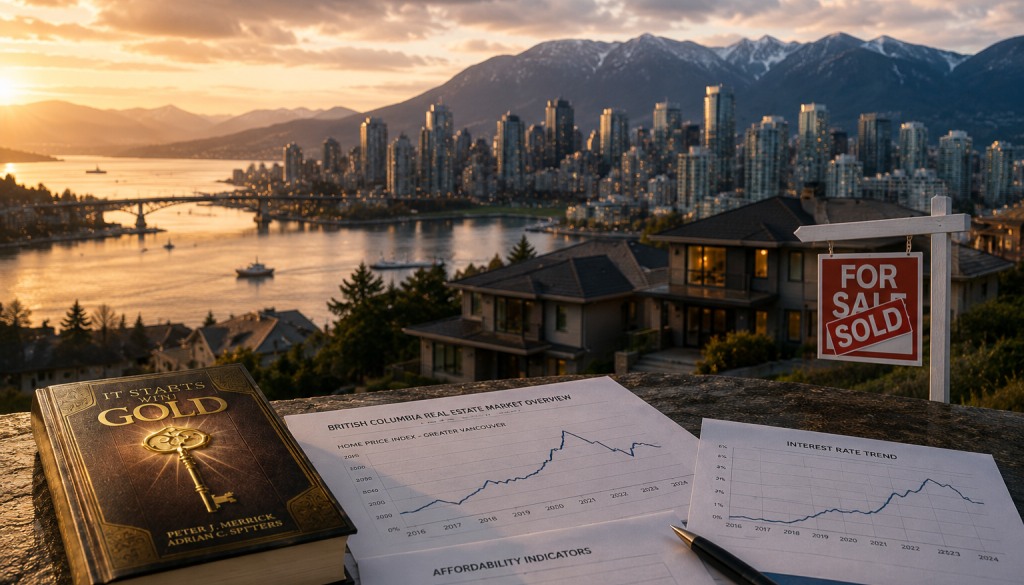
The Perfect Storm Forming Around British Columbia Real Estate
By Adrian C. Spitters, FCSI® and Peter J. Merrick, TEP®
This article is part of an ongoing series published through The Merrick Spitters Reset Report™ examining long-term developments affecting property rights, financial systems, and wealth preservation.
Why Some Families Are Quietly Beginning to Reassess the Assumptions Behind Their Wealth
For most of the past two decades, many British Columbians came to believe that real estate represented the safest and most dependable form of long-term financial security available to them. Peter Merrick and I have spent years sitting across kitchen tables, boardroom tables, and office desks listening to families talk about property almost as if it were a certainty rather than an investment. Homes became retirement plans. Rental properties became retirement plans. Vacation properties became retirement plans. In many cases, retirement assumptions, inheritance expectations, and even future family stability gradually became intertwined with the continued strength of British Columbia real estate.
Many families stopped thinking about diversification altogether. Why would they not? People watched ordinary detached homes in Vancouver and the Fraser Valley appreciate more in a few years than some businesses generated in decades. Parents began borrowing against homes to help children enter the market. Business owners leveraged real estate to expand operations. Retirees quietly counted on property appreciation to offset rising living costs later in life. Entire generations psychologically shifted from viewing housing as shelter to viewing housing as the primary engine of long-term financial security.
Peter and I have watched this mentality slowly deepen over time. We have also watched what happens during major financial cycles when assumptions that once appeared permanent begin gradually changing. One of the most important lessons we have learned over decades inside financial services is that major transitions rarely announce themselves all at once. Instead, they begin emotionally. Conversations change first. Confidence follows shortly after. Perceptions surrounding an asset often shift long before most people fully recognize what is happening structurally underneath. Over the past year, we have increasingly felt that emotional shift beginning to emerge across portions of British Columbia real estate.
Many of the issues discussed in this article are explored in greater depth at a structural level in The Ownership Stewardship Framework™. That publication examines how ownership systems, governance frameworks, confidence, and capital allocation interact to influence long-duration assets such as real estate. While this article focuses primarily on the practical and emotional consequences many British Columbia property owners are beginning to experience, The Ownership Stewardship Framework™. explores some of the deeper forces that may be contributing to the conversations now emerging across the province.
The Conversations Are No Longer the Same
A few years ago, most conversations surrounding British Columbia property carried an entirely different tone. Clients wanted to know whether they should buy another rental property. They wanted to know whether they should leverage more equity. Many worried that if they waited too long, their children would never be able to enter the market at all. There was a kind of emotional certainty underpinning almost every real estate discussion. People were not asking whether the market could weaken. They were asking how much higher it could go.
Today, however, the conversations feel noticeably different than they did only a few years ago. The emotional tone surrounding British Columbia real estate has shifted in subtle but increasingly important ways.
Peter and I increasingly hear hesitation where confidence once existed. We hear exhaustion where excitement once existed. More families are quietly asking whether the future will continue behaving the way people had grown accustomed to for most of the past two decades. What is striking is that these conversations are not always happening with people who are financially struggling. In many cases, they are happening with successful families who, on paper, appear extraordinarily wealthy because of what has happened to their real estate holdings over time.
That is part of what makes the situation psychologically complicated for many families. On paper, they may appear financially secure, yet emotionally, they are increasingly questioning whether the assumptions supporting that apparent security remain as stable as they once believed.
Many people still look wealthy on paper. Their homes may have appreciated dramatically. Their rental properties may have generated enormous unrealized gains. Yet beneath the surface, some are beginning to feel increasingly uneasy about how dependent their future has become on one regional asset class continuing to behave exactly the way it behaved during a completely different financial era.
That emotional shift matters far more than most people realize because psychology often changes before broader market behaviour fully adjusts. Families rarely wake up one morning and suddenly abandon long-held assumptions. Instead, confidence slowly erodes over time while people continue trying to emotionally anchor themselves to a previous environment that may no longer exist in the same way going forward.
When Paper Wealth and Real Liquidity Begin Separating
One of the themes Peter and I keep hearing repeatedly now revolves around liquidity, although most people do not initially use that word directly. Instead, it emerges indirectly through conversations. Someone casually mentions that a property has been sitting longer than expected. Another person mentions that showings have slowed dramatically compared to several years ago. Someone else mentions that financing approvals no longer feel automatic. Realtors begin describing markets that feel thinner and less stable internally.
Peter and I increasingly hear subtle changes in tone, even in ordinary conversations, throughout the Fraser Valley. People who once spoke confidently about renovation plans, refinancing opportunities, or purchasing additional properties now sound noticeably more cautious. Some openly admit they are watching listings sit longer than expected in certain neighbourhoods. Others speak about rising carrying costs or uncertainty surrounding future financing conditions in ways that would have felt unusual only a few years ago.
Because I spent most of my life living and working in British Columbia, particularly throughout the Fraser Valley, many of the changes discussed throughout this article are things I have personally watched unfold in real time across the province over decades. Peter, meanwhile, spent much of his career based in Toronto and observed many of the same psychological patterns emerge throughout Ontario real estate during previous housing cycles. Since expanding much of his work into the United States in recent years, Peter has also begun observing similar emotional and structural pressures gradually emerging across portions of the American real estate market as well. Although this article focuses primarily on British Columbia because of the additional uncertainty now surrounding DRIPA, land-rights discussions, and evolving governance concerns, Peter and I both increasingly believe that many of the broader emotional, financial, liquidity, and ownership-related pressures discussed here are not isolated solely to British Columbia. Variations of these same underlying stresses are gradually beginning to emerge across other major Canadian and North American real estate markets as well, including portions of Ontario, the Greater Toronto Area, and parts of the United States.
Peter and I also increasingly believe many people still do not fully appreciate that UNDRIP is not solely a British Columbia or even Canadian discussion. Versions of these conversations surrounding Indigenous rights, land governance, title frameworks, and jurisdictional authority are gradually emerging across multiple countries that have adopted or aligned themselves with the United Nations Declaration on the Rights of Indigenous Peoples. While the legal structures and political realities differ significantly between jurisdictions, including Canada and the United States, the broader uncertainty surrounding land rights, governance interpretation, and long-duration ownership assumptions is not necessarily confined to British Columbia alone. In many ways, British Columbia may simply represent one of the earliest visible examples of how these discussions can begin influencing the emotional psychology surrounding real estate, governance, and long-term financial security.
For Peter and me, the deeper concern is not necessarily any single legal outcome, but rather how prolonged uncertainty itself can gradually begin influencing confidence, lending behaviour, investment decisions, and long-duration assumptions surrounding real estate ownership.
That distinction matters enormously because paper wealth and realizable liquidity are not the same thing. Peter and I increasingly encounter families who are beginning to realize that an asset appearing valuable on paper does not necessarily mean it can be converted into liquidity easily or on favourable terms during periods of changing market conditions.
Peter and I recently spoke with a couple in the Fraser Valley who had spent nearly thirty years building a portfolio of rental properties. For most of their lives, those properties represented safety and stability. They had worked hard, sacrificed heavily, managed tenants themselves, repaired units themselves, and slowly built what they believed would become a secure retirement structure later in life. On paper, they appeared extremely successful. Yet the way they spoke about those properties had changed completely. Rising carrying costs, increasing financing pressure, changing regulations, tenant challenges, and uncertainty surrounding future market conditions had slowly replaced the optimism they once felt.
What struck us most was not panic or emotional hysteria. It was exhaustion. After decades of believing real estate represented unquestionable stability, they no longer sounded excited about their portfolio. They sounded mentally exhausted by the growing uncertainty surrounding financing, taxes, liquidity, regulations, maintenance costs, and the increasingly difficult realization that the future may not behave the same way the past did.
For the first time in decades, they were no longer asking how much further the market might rise. Instead, they were asking whether waiting too long to reduce exposure could eventually leave them trapped alongside too many other sellers trying to exit at the same time.
For us, that represents a profoundly different kind of conversation than the ones we became accustomed to hearing throughout most of the previous real estate cycle. The emotional certainty that once surrounded property ownership no longer feels nearly as absolute for some families as it once did.
Something Beneath the Surface Is Changing
Peter and I increasingly believe the emotional foundations supporting British Columbia real estate are no longer as stable as they once appeared. The concern is not necessarily that every segment collapses simultaneously, but rather that many of the assumptions supporting the previous cycle may no longer be functioning with the same strength they once did.
Many British Columbians still understandably assume that housing shortages alone guarantee future appreciation and permanent market strength. Peter and I understand why people think that way because, for years, the market rewarded that assumption repeatedly. Yet what we are increasingly observing is that several conditions supporting the previous real estate cycle may now be weakening simultaneously.
Affordability has deteriorated dramatically for younger households. Mortgage payments have surged higher as low-interest-rate loans reset into a completely different borrowing environment. Some condo markets are showing visible weakness beneath the surface. Assignment sales have become more difficult. Investor demand has softened in portions of Greater Vancouver. Some developers are delaying projects, redesigning projects, discounting inventory, or walking away from developments entirely because the economics no longer work the way they once did.
The public still sees cranes across skylines and assumes the system remains fundamentally stable. Yet Peter and I increasingly hear concern from people directly connected to construction, financing, development, and real estate sales who openly acknowledge that many projects no longer “pencil” economically the way they did even a few years ago.
That matters because the emotional tone among sophisticated market participants often begins changing before the broader public fully recognizes the implications. We have seen this dynamic unfold during previous cycles where confidence gradually weakens among industry participants long before broader public sentiment fully adjusts.
Several years ago, conversations around condominium development often carried a sense of inevitability. Demand seemed endless. Financing appeared abundant. Buyers lined up for pre-sales almost automatically. Today, many of those conversations feel far more cautious. Some developers are struggling to achieve financing thresholds. Some buyers are unable to close on units purchased during peak-market conditions. Some investors who once treated condos as nearly guaranteed appreciation vehicles are now discovering that liquidity can disappear much faster than expected.
We have watched enough cycles over the years to recognize that markets often feel strongest emotionally near the point where underlying mechanics quietly begin weakening internally.
The Emotional Shift Around Real Estate Is Becoming More Visible
Perhaps the most important change Peter and I are noticing is psychological rather than statistical. The way many British Columbians emotionally view real estate appears to be gradually changing, even before the broader market consensus fully adjusts.
For years, many British Columbians psychologically stopped viewing real estate as cyclical. The Lower Mainland began feeling almost immune to traditional market forces. Many people genuinely believed there would always be another buyer willing to pay more later. That belief became deeply embedded across multiple generations.
Increasingly, Peter and I hear ordinary people quietly asking questions they would not have considered only a few years ago. Some wonder what happens if too many investors eventually attempt to sell simultaneously into weakening liquidity conditions. Others worry about mortgage renewals continuing to strain household cash flow or whether younger buyers can realistically absorb current price levels going forward. Some quietly question whether real estate will continue behaving the same way it did during the falling-interest-rate environment that shaped most of the previous cycle. What is striking is not necessarily the fear itself, but the growing realization that more people are beginning to question assumptions that once felt almost unquestionable.
These are no longer fringe conversations confined to a small group of pessimists or market skeptics. Peter and I increasingly hear variations of these concerns from ordinary property owners who spent years believing British Columbia real estate represented one of the safest and most reliable ways to build multi-decade financial security available in Canada.
For many families, those concerns are now beginning to intersect with a second layer of uncertainty surrounding land rights, governance structures, and evolving legal interpretations connected to DRIPA and UNDRIP.
The DRIPA Conversation Is Adding Another Layer of Uncertainty
At the same time, another issue has begun increasingly unsettling many property owners across British Columbia: growing confusion and uncertainty surrounding DRIPA, UNDRIP, Aboriginal title discussions, and evolving conversations around land rights and governance.
Peter and I have noticed that many ordinary homeowners do not fully understand the legal details involved, but they are increasingly aware that something significant is being debated underneath the surface. In recent months, some British Columbians became deeply unsettled after hearing discussions surrounding court decisions connected to Aboriginal title claims and language suggesting that Aboriginal title could be viewed as “senior and prior” to fee simple interests under certain circumstances.
Whether those legal interpretations ultimately survive appeal is not even the primary emotional concern for many families. What Peter and I increasingly notice is that many ordinary homeowners simply feel unsettled by the growing realization that discussions surrounding land rights, ownership assumptions, and governance structures may become more complicated in the years ahead.
The deeper issue for many homeowners is uncertainty itself. Most people can emotionally tolerate volatility far more easily than they can tolerate not fully understanding how future conditions may evolve or whether long-standing assumptions surrounding ownership and stability are quietly changing beneath the surface.
Most homeowners are not constitutional lawyers. They are ordinary people trying to understand whether the assumptions surrounding ownership, title certainty, governance, and long-term stability may be changing in ways they do not fully understand. Peter and I increasingly hear confusion from people who never previously spent any time thinking about these issues at all.
Some ask whether lenders may eventually become more cautious. Others quietly wonder whether future buyers may hesitate if uncertainty surrounding ownership structures continues growing over time. For many ordinary property owners, the discomfort does not come from ideology or politics as much as the growing realization that they no longer feel entirely certain where the boundaries of ownership, governance, and long-term stability may eventually lead.
That emotional uncertainty matters because real estate markets depend heavily on confidence. Buyers need confidence. Sellers need confidence. Lenders need confidence. Developers need confidence. Once uncertainty begins entering long-duration assets, behaviour often changes long before final legal outcomes are ever fully resolved.
Peter and I are not suggesting people are about to lose their homes. That is not the point. The point is that many British Columbians are beginning to realize that assumptions they once believed were unquestionable may no longer feel as certain as they once did.
That realization alone can begin gradually altering behaviour long before final legal outcomes or policy directions are fully resolved. Once uncertainty enters a long-duration asset class, people often begin reassessing decisions, leverage, timelines, and risk exposure in ways that would have felt unnecessary only a few years earlier.
British Columbia Is Becoming a More Emotionally Fragile Market
Another thing Peter and I increasingly notice is that British Columbia real estate no longer feels psychologically synchronized the way it once did.
Some neighbourhoods remain relatively resilient. Some family-oriented areas continue attracting strong demand. Yet other segments feel increasingly fragile. Certain condo markets feel dramatically weaker than detached family neighbourhoods. Some investors still sound confident while others sound emotionally exhausted. Some sellers remain anchored to peak valuations while buyers quietly pull back beneath the surface.
We have learned over decades of observing financial cycles that markets rarely weaken evenly or predictably. Instead, they often fragment emotionally first as different groups of buyers, sellers, investors, and families begin interpreting risk through entirely different psychological lenses.
We have seen these kinds of emotional fractures emerge during previous financial cycles as market participants gradually begin interpreting risk through entirely different lenses. Confidence does not disappear all at once. Instead, people slowly begin interpreting risk differently depending on their age, leverage, liquidity, debt levels, and emotional flexibility. Families who once viewed the market similarly now increasingly interpret risk through very different lenses.
That fragmentation now appears increasingly visible across portions of British Columbia real estate.
The Tax Trap Keeping Many Investors Frozen
One of the most emotionally difficult conversations Peter and I increasingly have with property owners now revolves around taxes and embedded capital gains. In many cases, the emotional pressure does not come solely from uncertainty surrounding the market itself, but from the feeling that repositioning has become financially overwhelming.
Many property owners are not necessarily holding because they remain overwhelmingly bullish on the future. In many cases, they continue holding because the embedded capital gain inside the property has become so large that they feel trapped emotionally and financially.
We recently spoke with another couple who had accumulated several long-held rental properties over decades. They admitted privately that they had considered reducing exposure for years. Yet every time they explored selling, the projected tax consequences felt overwhelming. The result was paralysis. They no longer felt entirely comfortable remaining so concentrated in real estate, yet they also feared triggering a massive tax bill if they repositioned.
Peter and I increasingly believe that emotional paralysis surrounding embedded capital gains is becoming far more common than most people realize. Many families no longer feel entirely comfortable remaining heavily concentrated in real estate, yet simultaneously feel overwhelmed by the financial consequences associated with repositioning.
Many people now feel caught between two competing fears. On one side is the fear that market conditions could deteriorate further. On the other side is the fear of voluntarily triggering a major taxable event. As a result, some households remain heavily concentrated not necessarily because they feel fully optimistic, but because they feel uncertain how to transition safely without creating another financial problem in the process.
What Peter and I increasingly find is that many property owners are simply unaware that certain tax-oriented planning structures may exist that, depending on the client’s circumstances, can potentially help reduce a meaningful portion of the tax burden associated with repositioning appreciated real estate assets. In some cases, these types of strategies may allow families to improve liquidity, reduce concentration risk, or reposition portions of their balance sheet more efficiently than they originally believed possible. These strategies are not appropriate for everyone and require careful professional analysis, but many investors have never even been informed that such planning opportunities may exist.
In many cases, families spend years assuming a large tax event is unavoidable without ever realizing that alternative planning discussions may exist that could materially change the flexibility available to them.
This is why Peter and I increasingly believe many families holding rental properties, investment real estate, recreational properties, or highly appreciated real estate assets should begin having honest conversations with experienced realtors, financial advisors, accountants, and tax professionals while meaningful flexibility and optionality still exist. For some families, those conversations may ultimately reinforce the decision to continue holding long term. For others, however, they may raise serious questions about whether reducing exposure ahead of potentially worsening liquidity conditions deserves careful consideration before larger numbers of sellers begin reaching similar conclusions simultaneously.
Peter and I are certainly not suggesting that every family should sell, liquidate property holdings, or assume collapse is inevitable across every segment of British Columbia real estate. Some families may remain well-positioned to hold long term. Others, however, may need to reassess whether their current exposure still aligns with the risks, liquidity needs, emotional realities, and long-term assumptions now emerging across portions of the province.
Stewardship Looks Different During Transitional Periods
We have spent decades watching how people behave during major market cycles. One of the most consistent patterns we have observed is that people often continue making long-duration decisions based on assumptions formed during a completely different economic environment.
That is simply human nature. People naturally project the recent past forward and assume the conditions they became familiar with over many years will continue functioning similarly into the future, particularly after a prolonged period of financial success.
When an asset class performs extraordinarily well for long enough, people eventually stop questioning the underlying assumptions supporting it. Concentration becomes normalized. Liquidity becomes assumed. Diversification begins to feel unnecessary. The emotional memory of prior downturns slowly fades away.
Then, eventually, something begins changing beneath the surface of the market, often gradually at first and almost invisibly to most participants. Emotional certainty weakens before public consensus fully adjusts, and many people continue operating under assumptions that may no longer align with evolving conditions.
In many cases, they begin gradually while people continue trying to emotionally anchor themselves to assumptions formed during a very different economic environment.
Sometimes those changes emerge quietly through thousands of small conversations happening simultaneously across households, businesses, and communities. Sometimes they emerge emotionally through hesitation, fatigue, uncertainty, and the growing realization that the old assumptions may no longer feel as dependable as they once did.
That is increasingly what Peter and I believe we are witnessing today across portions of British Columbia real estate. The point is not to promote panic, predict catastrophe, or tell every family to liquidate their holdings immediately. Rather, it is about recognizing that the emotional, financial, and structural conditions supporting British Columbia real estate may be entering a very different phase than the one that shaped the previous generation’s expectations.
For some families, holding long-term may still make perfect sense. For others, however, this may be the moment to begin reassessing liquidity, diversification, leverage, concentration risk, tax exposure, and overall balance-sheet resilience before future conditions become materially harder to navigate emotionally and financially.
We increasingly believe many families holding highly appreciated rental properties, investment real estate, recreational properties, or concentrated real estate portfolios may benefit from having thoughtful conversations sooner rather than later regarding liquidity, embedded capital gains, tax-efficient repositioning strategies, and long-term balance-sheet resilience. In many cases, people are unaware that planning options may exist that could potentially help reduce tax friction while improving flexibility during changing market conditions. Even for families who ultimately decide to continue holding their properties long term, we believe these conversations are becoming increasingly important as the emotional and financial landscape surrounding British Columbia real estate continues evolving.
We increasingly believe these conversations are becoming less about speculation and more about stewardship, flexibility, and preserving long-term optionality while meaningful choices still exist.
In many ways, the goal is not necessarily to predict catastrophe, but to preserve flexibility before changing market conditions reduce the number of good options available to families later.
Families considering selling rental properties, investment real estate, recreational properties, or highly appreciated real estate assets may wish to better understand their potential tax exposure and whether planning strategies may exist to help reduce part of that tax burden based on their individual circumstances.
Those wishing to explore these issues further can use the calendar link below to book a meeting.
These conversations often help households better understand both the potential risks of continued concentration and the planning options that may exist if repositioning eventually becomes necessary.
To continue following Peter Merrick’s and Adrian Spitters’ ongoing analysis surrounding real estate, financial markets, liquidity risk, taxation, and long-duration wealth preservation strategies, readers can subscribe to The Merrick Spitters Reset Report™.
Readers interested in the broader philosophy surrounding asset security, liquidity, monetary instability, and long-term stewardship can also explore Peter Merrick and Adrian Spitters’ book It Starts With Gold™, which examines many of the structural, emotional, and psychological shifts now emerging across modern financial markets.
Stewardship during transitional periods often requires families to ask difficult questions long before the broader public fully recognizes why those questions matter.
The greatest risks often emerge when people continue making long-duration financial decisions based on assumptions formed during a completely different era.

Disclosure
This article is intended for educational and informational purposes only and does not constitute investment, legal, accounting, tax, or real estate advice. References to taxation strategies, portfolio restructuring, alternative investments, productive-resource sectors, liquidity planning, or broader wealth-preservation themes are generalized discussions and may not be appropriate for every individual or household situation.
Every investor’s circumstances, objectives, liquidity needs, tax position, and risk tolerance are different. Readers should consult qualified legal, tax, accounting, real estate, and investment professionals before implementing any strategy discussed or referenced in this article.
This article reflects general observations, opinions, and educational commentary regarding evolving real estate conditions, investor behaviour, liquidity risk, taxation, and long-term wealth-preservation considerations. References to British Columbia real estate markets, DRIPA, Aboriginal title discussions, inflation, financing conditions, commodity cycles, or broader economic trends are interpretive in nature and should not be viewed as predictions, guarantees, or assurances regarding future outcomes or investment performance.
All investments and real estate decisions involve risk, and future outcomes may differ materially from historical experience.
About the Authors
Adrian C. Spitters is a Canadian private wealth advisor with more than thirty-eight years of experience helping business owners, professionals, retirees, and farm families navigate long-term wealth preservation, liquidity events, and financial uncertainty. Raised on a dairy farm in British Columbia’s Fraser Valley, Adrian brings a practical understanding of stewardship, asset protection, and the pressures facing multi-generational families in changing economic environments. He is the co-author of It Starts With Gold™ and publisher of The Merrick Spitters Reset Report™. Read Adrian C. Spitters’ full biography here.
Peter J. Merrick is an international speaker, educator, and estate-planning specialist with more than three decades of experience advising business owners, professionals, and family enterprises across Canada and the United States. His work focuses on succession planning, long-term wealth preservation, and helping families structure and transition wealth across generations. Peter is the co-author of It Starts With Gold™ and continues contributing to conversations surrounding financial resilience, continuity, and stewardship. Read Peter J. Merrick’s full biography here.
References
- Government of British Columbia. “Declaration on the Rights of Indigenous Peoples Act.” Province of British Columbia. Accessed May 2026.
- United Nations. “United Nations Declaration on the Rights of Indigenous Peoples.” United Nations Department of Economic and Social Affairs. Accessed May 2026.
- Canada Mortgage and Housing Corporation. “Housing Market Information Portal.” CMHC. Accessed May 2026.
- Bank of Canada. “Policy Interest Rate.” Bank of Canada. Accessed May 2026.
- Government of Canada. “Indigenous Rights and Self-Determination Discussions.” Crown-Indigenous Relations and Northern Affairs Canada. Accessed May 2026.
- Fraser Institute. “Housing Affordability and Real Estate Trends in British Columbia.” Fraser Institute. Accessed May 2026.
- British Columbia Real Estate Association. “Market Intelligence and Housing Forecasts.” BCREA. Accessed May 2026.
- Office of the Superintendent of Financial Institutions Canada. “Residential Mortgage Risk and Lending Guidance.” OSFI. Accessed May 2026.