Why Tariffs Could Be the Wake-Up Call North America Needs
By Peter J. Merrick, TEP® and Adrian C. Spitters, CFP®, co-authors of the international bestseller It Starts With Gold™ and the forthcoming book Guns, Gold & Land™
This analysis continues a series of long-form investigations published in The Merrick Spitters Reset Report™
Tariffs Are Not the Threat. They Are North America’s Path Back to Strength and Sovereignty
For decades, Canadians and Americans alike were taught that tariffs were bad economics. They were told tariffs lead to higher prices, fewer choices, and strained international relations. But that narrative only told half the story. Tariffs, when applied with purpose, are not a relic of the past. They are a modern tool for restoring fairness, protecting national interests, and rebuilding domestic strength.
The fear of tariffs was never truly about economics. It was about control. It was about who stood to lose if nations like Canada and the United States reasserted authority over their supply chains, labour markets, and strategic sectors. For too long, the real winners of global trade were not local businesses or workers. They were multinational corporations and unelected global regulators.
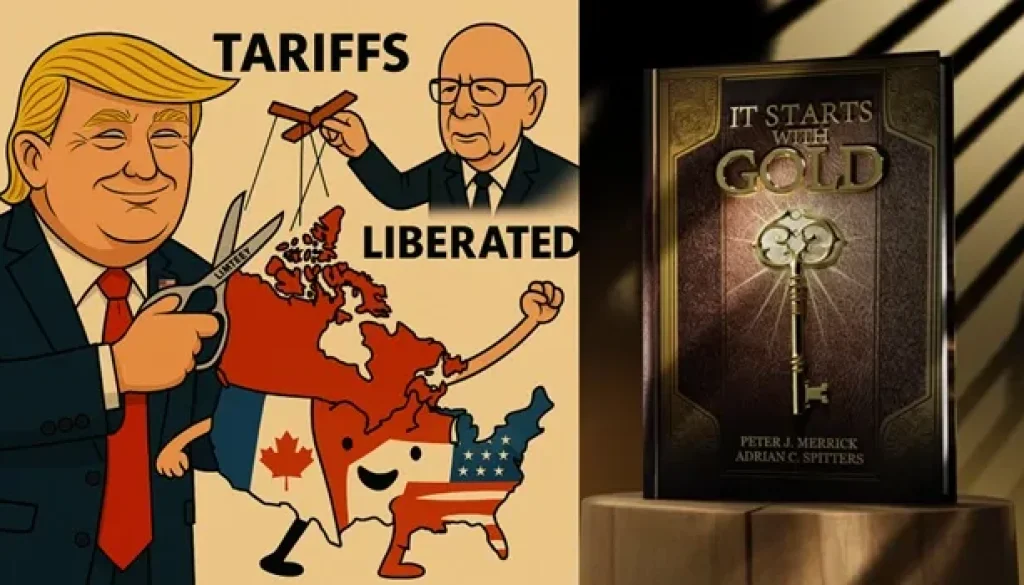
This theme runs deep in the international number one best-selling book It Starts With Gold, co-authored by Peter J. Merrick and Adrian C. Spitters. The authors argue that reclaiming sovereignty begins with real assets and real control, whether in trade, money, or production. Tariffs, like gold, are a strategic shield against foreign dependency and systemic fragility.
How Canada and the U.S. Got Trapped by Global Trade Rules
After the Second World War, North America embraced the promise of global free trade. Multilateral institutions like the World Trade Organization and the International Monetary Fund encouraged countries to dismantle tariffs and integrate into a shared economic system. The theory was that open markets would bring prosperity for all.
Canada and the United States followed suit. They slashed tariffs, opened their markets, and invited foreign producers to compete on home soil. In return, they were promised efficiency and growth.
But while North America played by the rules, many others did not. Countries like China kept their markets closed, subsidized domestic manufacturing, and used North America as a dumping ground for cheap goods. Over time, supply chains were hollowed out. Essential industries left. What was sold as free trade became a managed system that benefitted offshore producers and weakened national sovereignty.
The authors of It Starts With Gold warn that this is not just a story of trade. It is a story of extraction. Value was siphoned out of communities and transferred to centralized powers. Nations gave up the capacity to produce in exchange for temporary convenience.
Trump’s Return Brings Tariffs Back Into Focus
Now in his second term, President Donald Trump has reasserted his signature strategy. Tariffs are not being used as punishment but as leverage. In 2025, his administration expanded tariffs on electric vehicles, solar components, and steel to combat foreign dumping and protect strategic industries. His approach has shifted the global conversation on trade once again.
Trump is making it clear. Countries that want access to American markets must play fair. This means eliminating backdoor transshipments through Canada, addressing currency manipulation, and holding foreign producers accountable for environmental and labour standards. It is a new era of economic realism.
Canada, once a passive observer, is now under pressure to choose. Will it stand with North American interests or continue facilitating offshore access to domestic markets?
A North American Reset Beats the Globalist Reset
The stakes are no longer theoretical. The globalist model, with its emphasis on centralized control, fragile interdependence, and unaccountable institutions, is being challenged. Trump’s tariffs are part of a broader movement to rebuild from the inside out. And Canada must decide whether it will be part of this reset or left behind.
A North American Reset prioritizes resilience over reliance. It means building secure supply chains, producing energy at home, and protecting food systems from external disruption. It is not about closing borders. It is about protecting what matters most when the world becomes uncertain.
North America has the workforce, the land, the capital, and the technological capacity to produce what it consumes. There is no reason to depend on foreign regimes for the most basic necessities of life. Trade must serve sovereign interests, not abstract global goals set by distant bureaucracies.
This philosophy mirrors the core message of It Starts With Gold. The authors illustrate that the future will not be shaped by who can import the most but by who can endure and adapt. Just like owning physical gold secures financial independence, using tariffs secures national independence.
Tariffs Are a Tool for Freedom, Not Fear
Critics continue to warn about rising prices. But they ignore the far greater cost of inaction. The cost of empty factories, shuttered main streets, and insecure supply chains. The cost of losing the ability to respond to crisis without foreign approval.
Tariffs send a signal that a country is serious about its economic survival. They protect domestic producers from predatory pricing. They support local jobs. They reduce exposure to hostile governments. And they incentivize investment at home.
Perhaps most importantly, they remind multinational corporations that access to North American consumers is a privilege, not a right. If they want to sell here, they must build here. That message has returned under Trump. Canada would be wise to echo it.
One Fight, Two Nations, One Future
Canada and the United States remain the backbone of a shared North American destiny. Bound by geography and history, the two nations have every reason to align their interests in the face of global instability. If they embrace a common trade strategy rooted in reciprocity, transparency, and sovereignty, both can prosper.
This is not about protectionism. It is about protecting the capacity to produce what matters. It is about having the freedom to choose what we eat, how we power our homes, and whom we rely on when the world turns volatile.
True independence means having the tools to shape your future. Tariffs are one of those tools. And in today’s fractured world, they may be the only thing standing between self-reliance and permanent dependence.
The Choice Before Canada
President Trump has drawn the line. America will no longer subsidize the rise of its adversaries or allow its industries to be undercut by unfair competition. Canada now faces its moment of decision. Will it adopt the same mindset, or will it remain a conduit for foreign influence?
This is not a debate over ideology. It is a matter of survival. If Canada wants to remain a nation that produces, not just consumes, then it must reclaim control over trade, production, and policy. Tariffs are not the threat. They are the signal that sovereignty still matters.
Understanding why they matter and what they protect is the first step toward a stronger future.
👉 Discover how protecting your financial sovereignty starts with tangible assets. It Starts With Gold is the international number one best-selling book co-authored by Peter J. Merrick and Adrian C. Spitters: ttps://mybook.to/GOLD