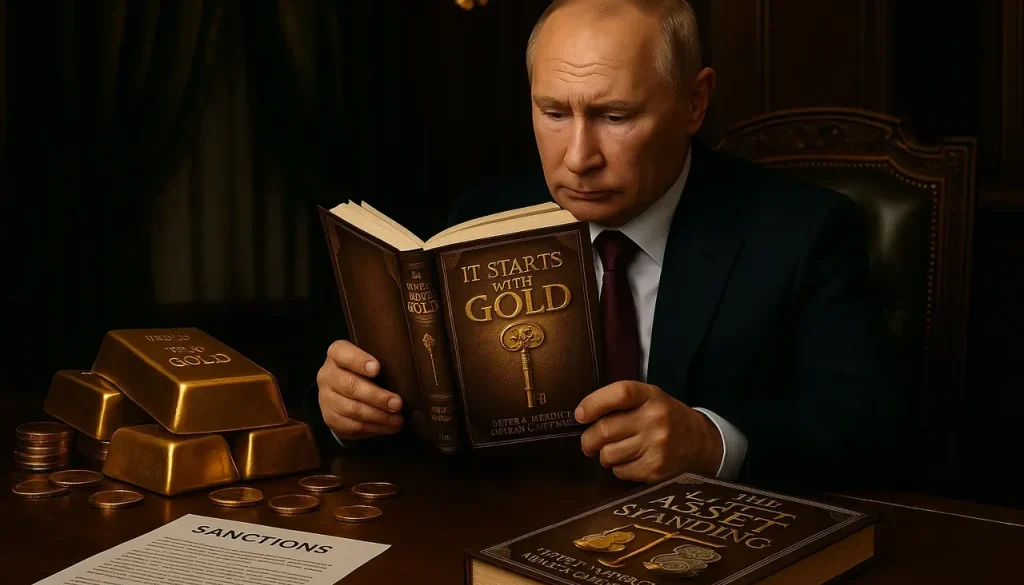
Dollar Under Fire: U.S. Sanctions Spark Global Reset
By Peter J. Merrick, TEP® and Adrian C. Spitters, CFP®, co-authors of the international bestseller It Starts With Gold™ and the forthcoming book Guns, Gold & Land™
This analysis continues a series of long-form investigations published in The Merrick Spitters Reset Report™
Washington’s weaponization of the dollar may be the spark that ends its global dominance
This article explores how escalating United States (U.S.) sanctions are weakening the U.S. dollar and accelerating a shift toward alternative trade and settlement systems anchored by gold and new blocs. It is written as an original opinion piece to inform and engage readers.
Some argue the U.S. dollar is untouchable. Others see it nearing its breaking point.
Jeffrey Sachs, a globally recognized economist, recently warned that Washington’s new sanctions threats against the Russian Federation are “dangerous,” “unworkable,” and could “accelerate the breakup” of U.S.-led economic blocs. Behind his words lies a broader truth: America’s financial coercion may be corroding the very foundation of its power.
Stay informed. Stay protected. Subscribe to It Starts With Gold™ on Substack to get the latest article straight to your inbox. 👉 SUBSCRIBE HERE
This is not only about Russia. It is about the decline of a U.S.-centric financial order that has shaped global trade since the mid-20th century and the rise of a multipolar world defined by commodities, alternative currencies, and gold.
Sanctions Are Backfiring
The United States has long used sanctions to exert influence without military conflict. Yet each time Washington weaponizes the U.S. dollar, disconnecting rivals from the Society for Worldwide Interbank Financial Telecommunication (SWIFT), headquartered in La Hulpe, Belgium, freezing their reserves, or threatening secondary sanctions, it signals that its financial infrastructure is unsafe for dissenters.
This dynamic is triggering a shift:
-
-
- De‑dollarization is gathering pace. Countries like the Russian Federation, the People’s Republic of China, and the Republic of India now conduct oil and gas trade in the Chinese yuan (CNY), Russian rubles (RUB), Indian rupees (INR), and even gold.
- Allies are hedging. Many European and Middle Eastern governments are pursuing alternative systems to reduce reliance on U.S. enforcement mechanisms.
- BRICS is consolidating. BRICS, an economic bloc consisting of the Federative Republic of Brazil, the Russian Federation, the Republic of India, the People’s Republic of China, and the Republic of South Africa, and their expanded members are building trade settlement platforms outside the U.S. dollar system.
-
Rather than isolating Russia, Washington risks isolating itself from the fastest growing global trade corridors.
The Petrodollar System Is Crumbling
Since the 1970s, oil trade priced almost exclusively in U.S. dollars, the petrodollar, provided the backbone of dollar dominance. That foundation is weakening.
Russia now sells energy to India and China in local currencies or commodity exchange. The Kingdom of Saudi Arabia, long a pillar of petrodollar stability, is advancing non‑dollar trade agreements while deepening ties with BRICS countries.
If energy trade no longer requires the U.S. dollar, the central pillar of America’s global economic leverage starts collapsing.
The Flight to Gold
As faith in the U.S. dollar erodes, central banks are accelerating gold purchases at historic rates. Metals Focus, a global precious metals consultancy based in London, United Kingdom, projects global central bank purchases of around 1,000 tonnes in 2025, the fourth straight year above 1,000 tonnes, a trend that marks strategic reserves diversification away from U.S. dollar assets.
The World Gold Council (WGC), headquartered in London, United Kingdom, reports record global gold demand in the second quarter of 2025: a 45 percent increase in value year‑on‑year to US $132 billion and 1,249 tonnes in volume. Central bank buying remained about 41 percent above the 2010–2021 quarterly average even as overall volume rose modestly by 3 percent. Exchange-traded fund (ETF) inflows totalled 170 tonnes; bar and coin demand increased 11 percent, especially in Asia.
The European Central Bank (ECB), headquartered in Frankfurt, Germany, states that gold has surpassed the euro as the second‑largest reserve asset globally, making up about 20 percent of official global reserves compared with the euro’s 16 percent, and backed by over 36,000 tonnes of central bank holdings at the end of 2024.
The People’s Bank of China (PBOC), headquartered in Beijing, officially holds 2,299 tonnes by mid‑2025, although analysts suggest actual holdings could exceed 5,000 tonnes based on import data and market signals.
What This Means for the West
For the United States and its Western allies, the implications are urgent:
-
-
- Inflation Pressures. A weakening U.S. dollar drives higher costs for imported goods and services across the Western world. For countries whose economies are deeply tied to the dollar, this creates upward pressure on inflation.
- Trade Realignment. Nations long aligned with U.S.-centric trade systems may be forced to adapt. As BRICS trade expands and alternative settlement systems gain traction, traditional Western economic blocs face the risk of marginalization if they do not engage with these emerging frameworks.
- Sovereign Exposure. Many Western nations hold the majority of their foreign reserves in U.S. dollars with limited or no gold backing. In a post-dollar world, this leaves their financial sovereignty highly exposed.
-
Internationally, countries dependent on U.S. dollar stability share this vulnerability as its dominance erodes.
The Great Reset No One Voted For
This global realignment is not being debated in legislatures. It is unfolding quietly through trade agreements, central bank decisions, and BRICS initiatives.
If Sachs is correct, the U.S. ultimatum will not compel compliance. They will hasten a transition to a financial system where the U.S. dollar becomes just one currency among many. Meanwhile, physical gold, once dismissed, may become the backbone of global settlement mechanisms.
Real Protection Outside the System
The financial system is being rewired. Central banks are stockpiling gold as a hedge against economic uncertainty. Governments are promoting tokenized, programmable assets. BRICS is building a gold-backed ecosystem that rivals the U.S. dollar.
For individuals, the lesson is clear: do not confuse tokenized gold with real gold. As we argued in our #1 international best‑selling book, It Starts With Gold™, physical gold in personal possession remains the last truly independent asset in a world where cash, property rights, and financial access are becoming conditional, programmable, and surveillance-based.
The urgent themes explored here are expanded in our book It Starts With Gold™, co-authored by Peter J. Merrick and Adrian C. Spitters. We reveal how to navigate asset confiscation risk, resist surveillance finance and rebuild wealth beyond the programmable system. Visit www.ItStartsWithGold.com.
At our firm, we assist clients in structuring wealth by Owning Assets in Order of Asset Confiscation. We prioritize the most secure assets and safeguard what is most vulnerable.
Book your complimentary review to learn how to structure for the shifts ahead.
Final Thoughts
Central banks are building gold reserves to insulate themselves from policy risk. Governments are nudging citizens toward programmable money. BRICS countries are leveraging gold to challenge U.S. financial dominance. Western nations, heavily exposed to the dollar system and lacking sufficient gold reserves, face subordination in any new global order.
For individuals, the principle holds: true ownership matters. Tokenized claims are not equivalent to physical gold.
To find out more, order your own copy of It Starts With Gold™ from Amazon today. CLICK HERE
References
- Dollar cedes ground to euro in global reserves, IMF data shows
- Gold Surpasses Euro as Second-Largest Global Reserve Asset, ECB Says
- Gold demand soars on record prices amid market volatility
- Central banks on track for 4th year of massive gold purchases, Metals Focus says
- China may be secretly stockpiling gold. Why that spells trouble for the U.S. dollar.
- BRICS trade and economic growth statistics, 2024–2025 expansion and intra-BRICS trade growth
- Jeffrey Sachs Interview, Sputnik International, July 30, 2025
- International Monetary Fund COFER Data on Currency Reserves
- World Gold Council Central Bank Gold Purchase Reports